

Smith & Wesson (S&W) introduced their Mountain Gun series of double-action revolvers in the mid-1990s. The different models included an L-frame .357 Magnum, N-frame .41 and .44 Magnums, and an N-frame in .45 Colt. Now Lipsey’s has decided to roll out a couple more in calibers not included in the original series, including the Model 617 in .22 LR.
The Exclusive Lipsey’s S&W Model 617
Most of the Mountain Gun versions were crafted from stainless steel. Likewise, they all featured tapered barrels with an ejector rod shroud, ramp front sights, adjustable rear sights, and Hogue Mono-Grips. The “pencil” barrel’s reduced weight made them easier to tote in the fields and forests.
Unfortunately, the last of the Mountain Guns were discontinued in 2005. Fast-forward to the 2025 SHOT Show. Lipsey’s, in collaboration with S&W, reintroduced the Mountain Gun. The first was an L-frame Model 686 Plus, a 7-shot .357 Magnum. The other was an N-frame sixgun in .44 Magnum.
Advertisement — Continue Reading Below
Enter the Model 617-7 Mountain Gun
Just recently (late June), Lipsey’s announced two more Mountain Guns: the Model 610, an N-frame six-shooter in 10mm, and the Model 617, a K-frame in .22 LR, with a 10-shot cylinder. While the Model 610 looked interesting, to me, no handgun is more fun than a .22 rimfire. So, I made a request to Lipsey’s Sr. VP and Product Development Mgr., Jason Cloessner, for a .22 LR Mountain Gun to test and evaluate.
The test gun came in the usual S&W blue plastic carrying case with a foam-rubber lining. Besides the revolver, the contents in the case included an owner’s manual, safety padlock, S&W decal, and a discounted NRA membership application.
Advertisement — Continue Reading Below
As S&W catalogs two other versions of the Model 617, the .22 LR Mountain Guns official designation is the Model 617-7. In “S&W-speak,” the 6 indicates that it’s made of stainless steel. Similarly, the 17 is the model number of its parent, the Model 17 K-22 Masterpiece.
This 6-shot target revolver was introduced in 1947 and is still available today, in blued steel, with a 6-inch barrel. The Model 617-7 has the customary Mountain Gun features.
Its tapered barrel is 4.125 inches in length, and has an integral serrated rib on top, and an ejector rod shroud below. The rear sight is fully adjustable. However, the ramp front sight of the earlier Mountain Guns was replaced with a patridge-type sight, with a gold bead.
Advertisement — Continue Reading Below
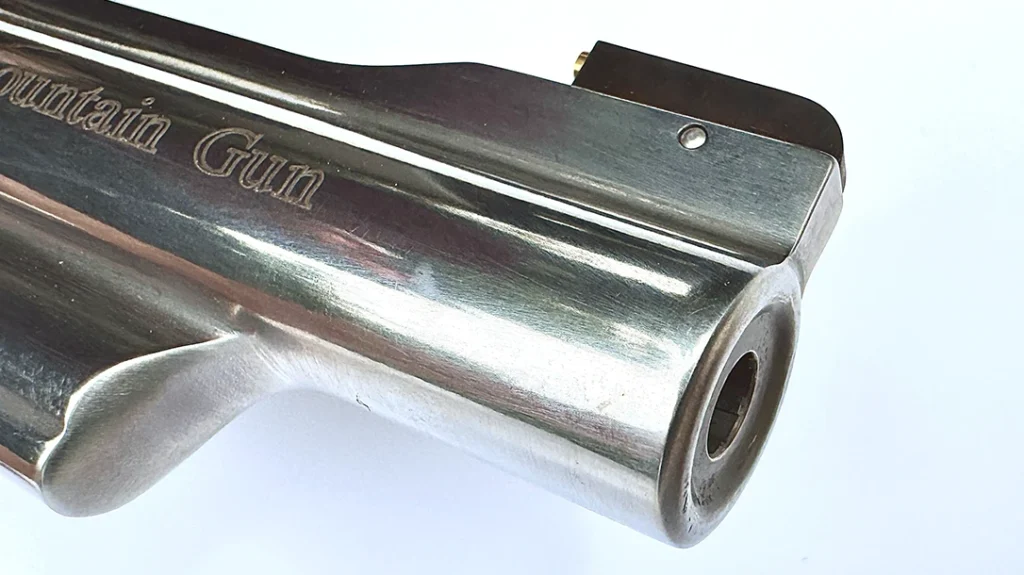
Another substitution is with smooth walnut Bear Hug grips by Tyler Gun Works, which have replaced the rubber Hogue Monogrips.
A No-Lock Design
Like many of the latest S&W revolvers, the Model 617-7 features a forward cylinder locking point on the front of the frame. It is a ball detent that engages a cutout in the crane/yoke. The full-length ejector rod is now one-piece and slimmer.
Advertisement — Continue Reading Below
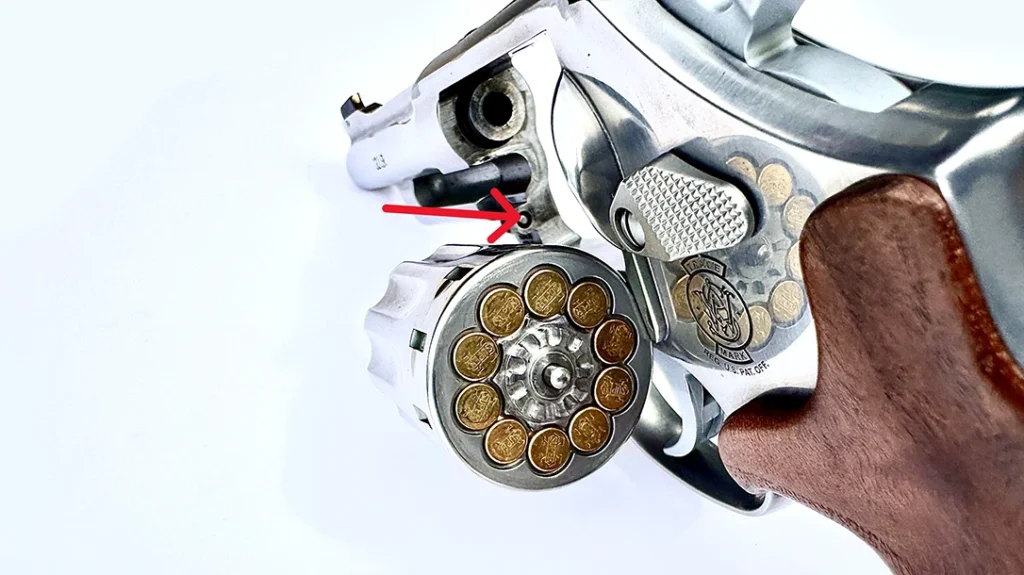
There’s a frame-mounted, rebounding firing pin, the cylinder stop is now built into the frame, and it has a checkered, rearward-sloping cylinder release latch. What is missing on this new Smith is the internal lock, with its hideous keyhole in the left side of the frame, just above the cylinder release latch.
To prevent accidental discharges, there’s an internal transfer bar in the action. This averts the hammer nose from contacting the firing pin unless the trigger is intentionally pulled.
Advertisement — Continue Reading Below
The hammer spur is wide and checkered, while the 0.25-inch-wide trigger is smooth-faced. My trigger pull gauge indicated the pull weight was a crisp 5 lbs. 5.5 oz. in single action (SA). Likewise, it provided a silky 10 lbs. 7.5 oz. in double action (DA).
Another common feature is the round-butt, K-frame-size grip frame with an unserrated backstrap.
Feeding the Wheelgun
I wanted a variety of .22 LR cartridges with different bullet weights, configurations, and in both standard and high-velocity. Rimfire firearms can be picky about the loads they prefer.
Advertisement — Continue Reading Below
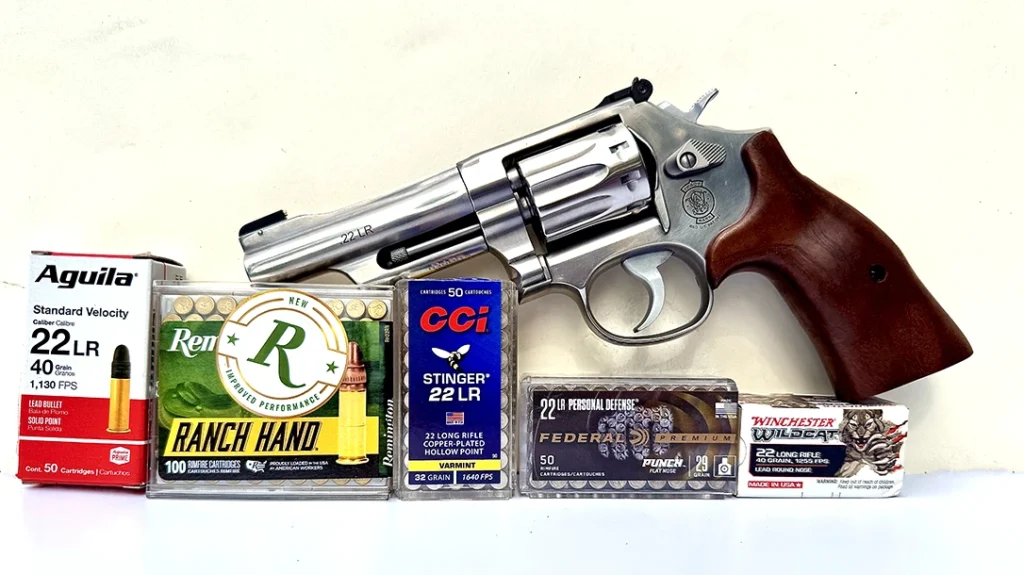
For a budget-priced plinking load, I selected the Mexican-made Aguila Standard Velocity. It has a 40-gr. solid-nose bullet and costs about 8¢ a shot.
My choice for a game/varmint load was the powerful CCI Stinger cartridges. They feature a 32-gr. copper-plated HP nose, and the cartridge case is nickel-plated.
Advertisement — Continue Reading Below
Another load with a nickel-plated case is Federal’s Punch, a round designed for personal defense. Its 29-gr. flat-nosed bullet is plated and has a silver coloration.
For a general field cartridge, I picked Remington’s Ranch Hand. It’s a high-velocity load with a 38-gr. plated HP bullet.
As an all-around load, my choice was Winchester Wildcat. It has a factory-rated velocity that puts it in the high-velocity category, and it has a 40-gr. solid-nose bullet.
Advertisement — Continue Reading Below
Carrying the Model 617
The Model 617 Mountain Gun will fit in any holster made for a 4-inch S&W K-frame revolver. So, I had a number of rigs to choose from. Rummaging through my holster and belt collection, I selected an outfit from El Paso Saddlery. I wanted leather with classic styling to complement this traditional-looking S&W wheelgun.
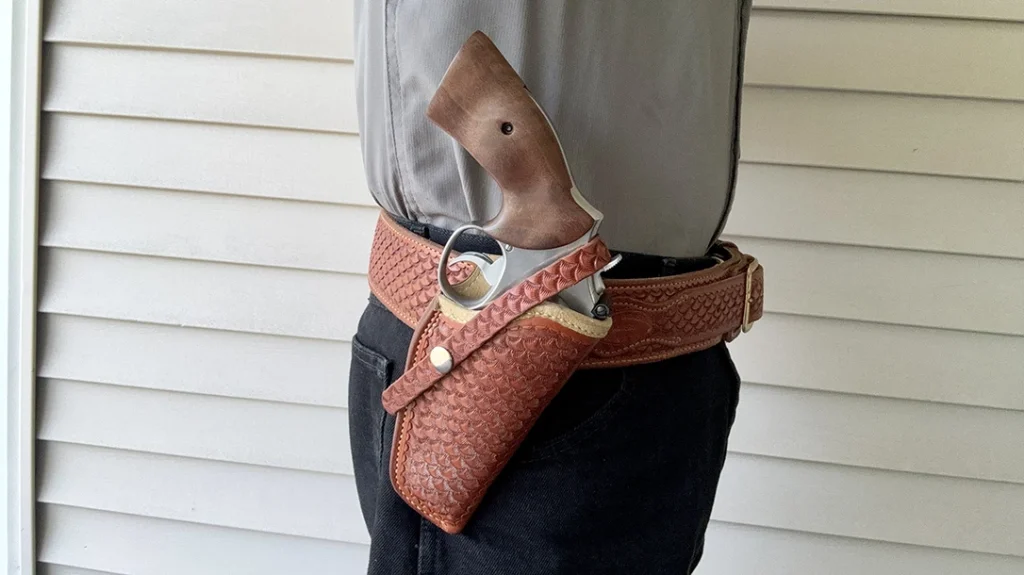
The 1920 “Tom Threepersons” holster was originally bought for my S&W Model 19. It’s a high-ride, forward-sloping belt model that’s lined and has a safety strap for retention. It has an exposed trigger guard, which wasn’t such a “thing” until striker-fired self-loaders came along.
My holster has a russet finish, fish-scale stamping, and a 2-1/4-inch belt loop. I mated it with a 2-1/4-inch-wide #150 “River Belt,” which is also lined and has the same russet color and stamping.
Shooting the Lipsey’s Model 617
The T&E shooting session was done at the local Range USA. I’m a member, and the ROs are always helpful and assist me with a few photographs.
Task number one was to set up my Garmin Xero Pro C1 chronograph and get bullet velocity figures on the .22 LR cartridges shot from the Model 617-7. That data is included in the accompanying performance table (below).
Simultaneously with getting the velocity information, I had a bullseye downrange at 15 yards, so I could also see where the bullet impacts were in relation to the sights. I found the lighter bullets shot 1.5 to 2.5 inches lower than the heavier bullets. So, I adjusted my hold on the target accordingly. Windage-wise, the Mountain Gun was shooting just a bit to the right.
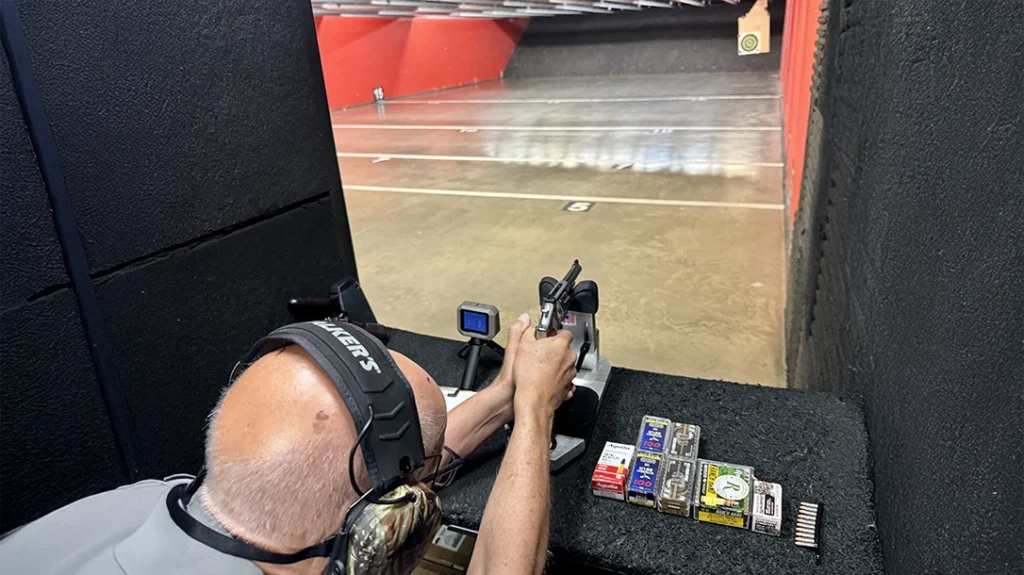
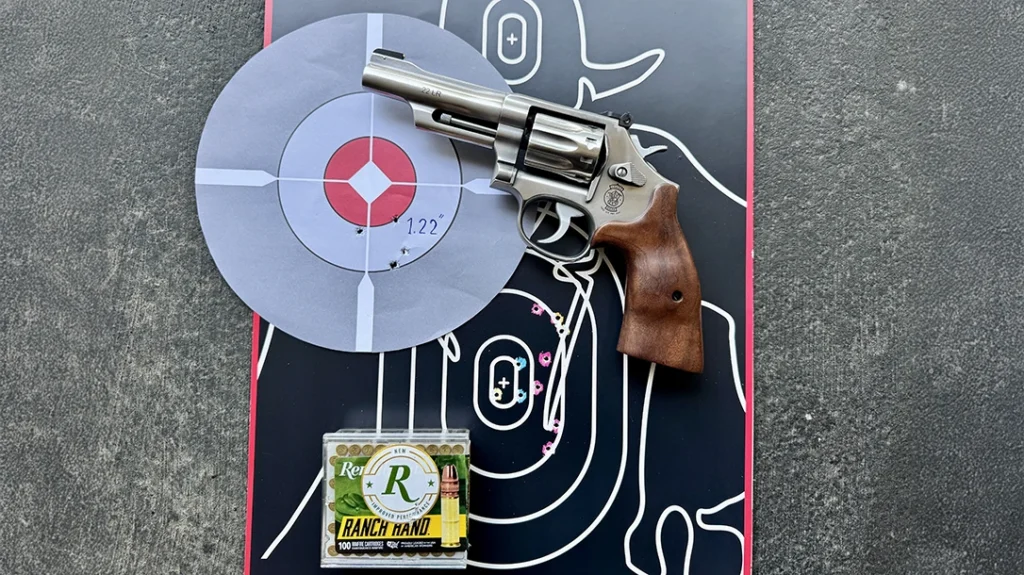
I sent a double bullseye target down to the 15-yard line for my accuracy potential evaluation. Three 5-shot groups were fired with each of the test loads. Shooting was done in single-action mode, from the bench, using a Ransom Steady Rest.
In recent months, I have been suffering from the “4+1 Syndrome.” I get four shots into a good group, and there’s that 5th shot that ruins what would have been a nice, tight cluster. To deal with this, if the flyer is way off, I’ve discounted it when I measure the group size. I’ve discovered this is a fairly common practice with the older set of gun scribes.
Anyway, I did get a real-live 5-shot group that measured 1.22 inches. It was made using the Remington Ranch Hand .22 LR load. Second place went to the Winchester Wildcat with a 1.46-inch 5-shot group. This cartridge also had the best group average at 1.65 inches.
The overall average for the 75 rounds fired was 2.22 inches.
Running the 617 in Double-Action
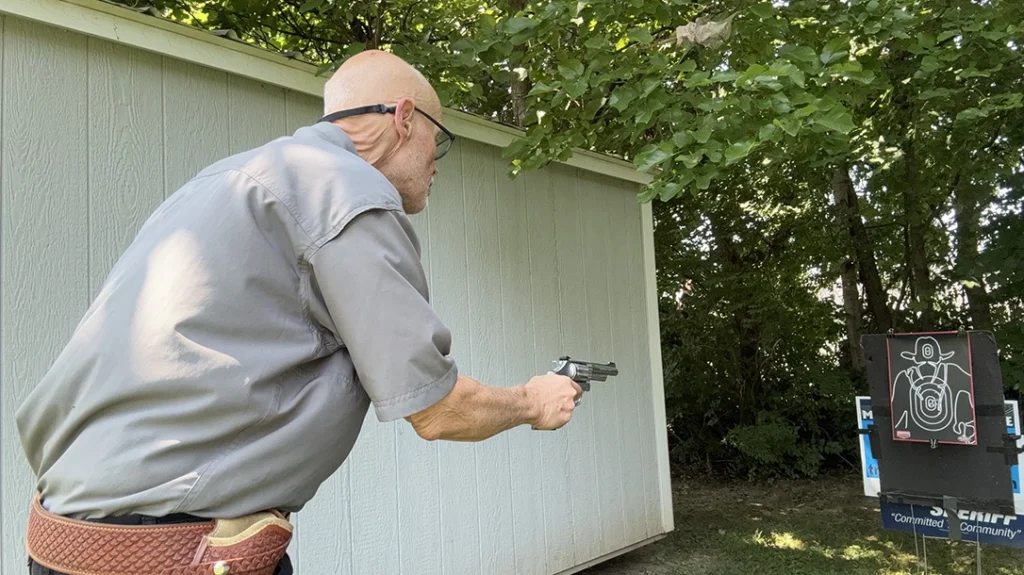
I’m not considering the Model 617 Mountain Gun for defense use. So, I decided to run a shooting exercise to see how reliable the Model 617-7 was in double-action mode.
Birchwood Casy had sent me samples of their new Dirty Bird Gunslinger targets, which have a cowboy silhouette with oval scoring rings. When a bullet impacts the target inside the scoring rings, the “halo” around the hole is a different color depending upon which ring it lands in.
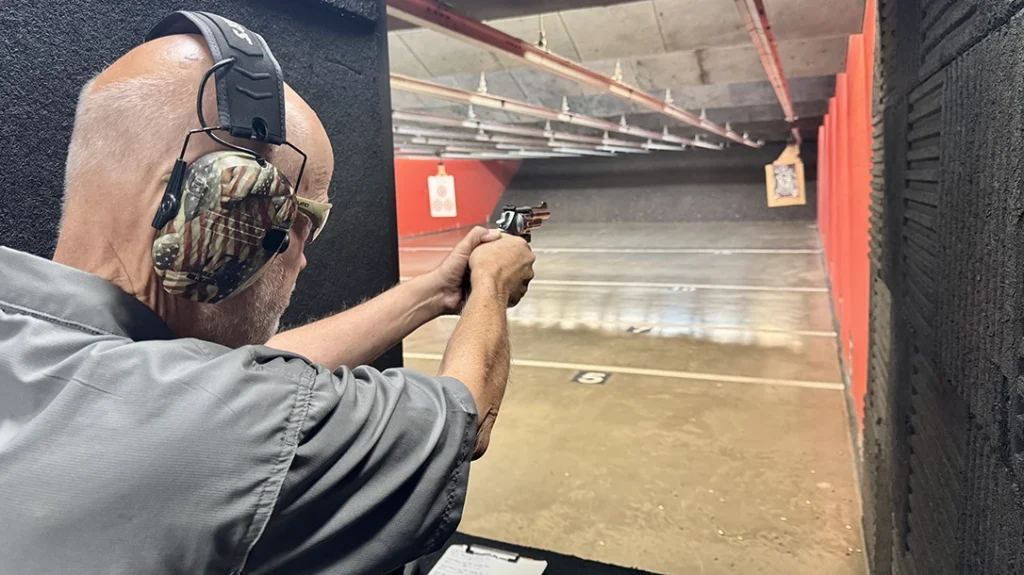
These targets were engaged at 10 yards, and I shot from a standing, unsupported position, using a two-handed isosceles stance. Shooting was done at a “timed-fire” cadence, holding center-mass of the reduced-size silhouettes. Ten shots were fired with each of the .22 LR test loads at each target.
My best 10-shot “group” again went to the Remington load, measuring 3.38 inches. Winchester came in second with a 3.97-inch cluster. Third went to Federal with 4.04 inches. Fourth went to CCI with 4.29 inches. Finally, the Aguila took last place at 4.42 inches.
Many bullet impacts went to the right because I did not make any sight adjustments due to the differing .22 LR loads. For reloading, I used a 10-shot .22 Quickstrip from Tuff Products.
The Truth Be Told
I didn’t mention this earlier, but a portion of the finish on the Model 617 Mountain Gun was disappointing. The metal-to-metal and wood-to-metal fit was excellent. However, the sandblasting done on the frame top-strap to reduce glare crept over onto the sides of the top-strap in the front and back.
This is something unusual on a test gun from S&W. Although it’s strictly aesthetics, it just looks haphazard.
What concerned me more was that during the DA shooting exercise, all the .22 LR cartridges, except for the Winchester Wildcat loads, had 1-3 misfires. Most of the dud rounds fired with a second strike of the firing pin. However, others had to be repositioned in the chamber before they went off.
Rimfire (RF) ammunition is like this, as the priming compound is spun into the inside of the hollow rim, and isn’t always uniform. However, this didn’t happen shooting SA, so I can’t completely blame the ammunition. Perhaps that nice DA pull-weight needs to be a bit heavier?
With less than 100% reliability, plus low muzzle energy figures (see table), I usually hesitate to recommend a .22 RF handgun for defense.
One other small item—it might just be me—but even though I love the gold bead front sights, they make it harder for my aged peepers to get a precise sight picture for bullseye paper-punching. In the field, on small game or varmints, especially with questionable lighting, they are super.
Lipsey’s and Smith & Wesson Get Two Thumbs Up
The full-length ejector rod on the Model 617-7 easily punched out empty cartridge cases. The Bear Hug grips from TGW fit my hand like a glove, and there were no issues regarding recoil/muzzle-flip.
In all other respects, the new .22 LR Mountain Gun ran at 100%. In my opinion, it will make a great stand-in for a K-frame centerfire revolver. It allows inexpensive practice with a revolver that has the same feel as your bigger-caliber defense gun.
Two thumbs for Lipsey’s and Smith & Wesson.
Lipsey’s S&W Model 619 Mountain Gun Specs
| Mechanism | Traditional double-action revolver |
| Caliber | .22 Long Rifle (LR) |
| Capacity | 10 cartridges |
| Barrel | 4.125 in. |
| Overall Length | 9.1 in. |
| Empty Weight | 36 oz. |
| Sights | Fully adjustable rear sight, gold bead front sight |
| Finish | Stainless-steel |
| Stocks | TGW walnut Bear Hug |
| MSRP | $1,199.00 |
Performance
| Aguila Std. Vel. 40 gr. Solid Pt. | |
| Average Velocity | 925 FPS |
| Best Group | 1.97 inches |
| Ave. Group | 2.39 inches |
| Ft-Pounds Muzzle Energy | 76 FPE |
| CCI Stinger Varmint 32 gr. HP | |
| Average Velocity | 1,259 FPS |
| Best Group | 1.78 inches |
| Ave. Group | 2.01 inches |
| Ft-Pounds Muzzle Energy | 113 FPE |
| Federal Punch 29 gr. Flat Pt. | |
| Average Velocity | 1,216 FPS |
| Best Group | 2.10 inches |
| Ave. Group | 2.78 inches |
| Ft-Pounds Muzzle Energy | 95 FPE |
| Remington Ranch Hand 38 gr. HP | |
| Average Velocity | 1,000 FPS |
| Best Group | 1.22 inches |
| Ave. Group | 2.25 inches |
| Ft-Pounds Muzzle Energy | 84 FPE |
| Winchester Wildcat 40 gr. Solid Pt. | |
| Average Velocity | 1,064 FPS |
| Best Group | 1.46 inches |
| Ave. Group | 1.65 inches |
| Ft-Pounds Muzzle Energy | 100 FPE |
NOTE: Bullet weight measured in grains, velocity in feet per second 15” from the muzzle by a Garmin Xero C1 Pro chronograph, and accuracy in inches for three 5-shot groups at 15 yards. FPE based on bullet weight and velocity.
WHY OUR ARTICLES/REVIEWS DO NOT HAVE AFFILIATE LINKS
Affiliate links create a financial incentive for writers to promote certain products, which can lead to biased recommendations. This blurs the line between genuine advice and marketing, reducing trust in the content.

