

The fastest way to waste money in a home shop is to buy a machine before you understand what accuracy actually costs.
Refining metallic instruments to create precise cuts that form new machines is not a new concept. For most of human history, metal was shaped by hand with hammers, files, and simple drills, and this is still a primary method. The modern era of machining really began in the late 1700s and early 1800s with the development of accurate, screw-cutting lathes and early milling machines during the Industrial Revolution. These machines made it possible to produce interchangeable parts, which transformed industries from firearms and clocks to steam engines and railroads.
Home Machining
Throughout the 19th century, advances in cast-iron machine frames, precision leadscrews, and standardized measurement systems steadily improved accuracy and repeatability. The 20th century introduced electric motors, high-speed steel, and later carbide cutting tools, surface grinders, and eventually numerical control and CNC machining, which enabled the consistent production of complex parts with minimal manual input. Over the past few decades, machining has advanced to micron-level precision with multi-axis CNC mills, EDM, advanced coatings, and digital metrology. Despite all of that advancement, the core principles have not changed. Rigidity, measurement, and controlled material removal still determine whether a part is right or wrong.
Advertisement — Continue Reading Below
At this point, I can hear you saying, “Okay, what does that have to do with me? I just want to turn some steel in my shop at home.”
Before you head out the door to pick up that sweet ol’ Bridgeport you found on Facebook Marketplace, there are a few questions worth asking yourself so you can figure out whether you are actually making the right move.
Advertisement — Continue Reading Below
Physical Reality & Big Machines
Bring a tape measure. Know what the machine weighs. Most of these machines weigh an incredible amount, and that is not accidental.
The term ‘not fitting’ is very general in this context. It may not fit through the door. It may not fit on your trailer. Your floor may not support it. Your shop layout may make it impossible to service or run safely. These are very real considerations that get ignored when people see a “deal.”
Another major consideration is power. Most of the large machines on the used market were retired from industrial applications that ran on 3-phase power. 3-phase is a type of electrical service that delivers electricity through three separate, evenly spaced waves instead of just one. Because the energy is more continuous, motors run more efficiently, with less vibration and better torque. That is why most industrial machines use it.
Advertisement — Continue Reading Below
The problem is that many homes only have single-phase power. Running 3-phase equipment often requires special service or a phase converter.
Phase converters are cool, and they can make the machine run, but you will not get true balanced 3-phase power. That means the machine will not perform exactly the way it was designed to. You may see reduced motor horsepower, rougher starts, extra heat, and less consistent torque, especially under heavier cuts.
I can hear you now. “Okay, Mitch, whatever, I just want to go buy the big machine.” I get it. Let’s step back for a minute and talk about what your home machining goals actually are.
Advertisement — Continue Reading Below
Accuracy & Repeatability: Not the Same Thing
The biggest determining question you should ask is simple. What level of accuracy and repeatability do I actually need?
There is a massive difference between general hobby machining, gunsmithing work, fixture and jig production, and true aerospace-level tolerance work. Holding .005” is achievable on almost any serviceable machine. Holding .001” typically requires a decent machine and a disciplined process. Once you get into .0001” and below, machine condition, environmental stability, and operator discipline become increasingly critical.
Before buying anything, you should ask yourself what tolerances you truly need to hold, on which materials, and across which part sizes. If your work is limited to sight cuts, scope bases, trigger components, or simple fixture plates, you likely do not need a $25K machine. If you intend to maintain precise slide rail geometry, cut bolt lugs, hold concentric bores on barrels, or achieve accurate thread timing, then machine rigidity, geometry, and overall build quality become critical.
Advertisement — Continue Reading Below
Weight Equals Accuracy
That big machine weighs so much because weight controls flex and chatter. That is what makes it more accurate.
A lot of people get fixated on the wrong specs like travel, horsepower, and swing size. The reality is that the machine’s mass, rigidity, bearing health, and condition of the ways are far more critical to its accuracy than anything printed on the spec sheet.
If the machine is light enough for you to pick up yourself, you are probably dealing with a hobby machine. That does not mean it is useless. It just means its envelope of capability is limited. Brass, aluminum, plastics, and light work in mild steel are realistic. You might be able to clean up an outer diameter on steel. You may even achieve decent precision once. The problem is repeatability. Precision once is not the same as precision every time.
Advertisement — Continue Reading Below
The Machine: Only a Factor
Another large consideration is that the machine itself is only one part of the system. Quality vises, collet systems, workholding, indicating tools, measuring tools, and basic cutting tooling are massive contributors to your end result.
Many people spend their entire budget on the machine and then wonder why their parts are inconsistent. The truth is that a rigid vise, a good collet system, and accurate indicators often matter more to your finished part than another inch of travel ever will.
Environment Matters
Something many people do not consider when starting a home shop is the environment.
Advertisement — Continue Reading Below
Precision machining does not tolerate temperature swings, flexible or uneven floors, poor lighting, or cluttered workspaces full of chips. Thermal expansion is very real. Even a 10-degree change can shift dimensions beyond your tolerance window. For consistent results, you want a stable temperature, a solid floor, a properly leveled machine, and controlled chip management.
Many people invest in precision equipment and run it in an unheated garage. Then they struggle to understand why their dimensions drift throughout the day.
Warm Up & Machine Condition
Once the machine is home and you are working, temperature still plays a major role. Warm-up and machine condition are real factors that many new machinists overlook.
Advertisement — Continue Reading Below
Older machines, in particular, tend to shift slightly when cold. As they run, the spindle expands with heat while the ways settle into their operating position during the first hour or so. These small changes can affect tolerances more than people expect. That is why machines should be allowed to warm up before attempting any true precision work.
It is a simple habit, but it separates casual use from consistent, repeatable results.
Tooling and the Truth
Tooling quality is huge. Often it matters just as much as, and sometimes more than, the machine itself.
Many beginners assume that buying an expensive mill automatically guarantees precision. The reality is that a cheap or poorly made endmill can produce tapered or inconsistent cuts, no matter how good the machine is. Cutting tools are the point of contact between the machine and the material. Their condition directly and drastically affects the outcome. A worn endmill will destroy precision faster than a worn machine ever will.
Critical Measurements
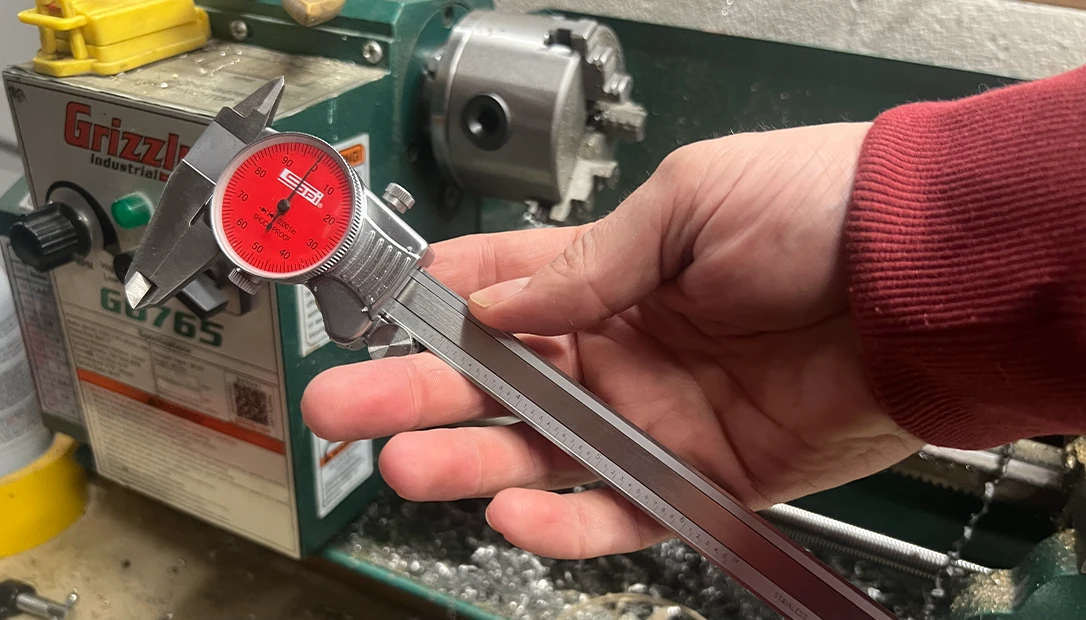
Your measuring capability must always exceed your machining capability. You cannot reliably hold a tolerance tighter than you can measure.
If your only tools are basic calipers, with no tenths indicators or micrometers, true precision work is simply not possible. At a minimum, serious precision requires a micrometer set with a range of 0 to 1 inch, a dial test indicator, gauge blocks or another reference standard, quality calipers for rough checks, and a surface plate. The machine removes material. Your measuring tools confirm whether you actually hit the number.
The Gap
At this point, you may feel like I am just beating up your idea to go buy that big machine from the mill two towns over that is going down and out.
I get it. Machining work at home can be fun, convenient, and even profitable in the right context. But there is a very real gap between reality and true milling precision.
If you are buying an old Bridgeport and shopping for a Grizzly for a new lathe, that is not a bad place to start. Most of those tools will excel at touch-up work, prototyping, or making fixtures. Replicating factory work done on massive production machines is very difficult in a home shop. You can get there, but it takes time, attention to detail, and patience. It may not be as repeatable as you hoped.
There is an old saying that still holds true. Time equals money. If you are spending hours trying to make a process repeatable, it is not very profitable.
The machine is only a tool. Precision comes from rigidity, measurement, environment, and discipline. If you understand those first, even a modest machine can do impressive work. If you do not, even the biggest mill in the county will not save you.
Finishing Pass
Before I leave you, a few things that matter more than any tolerance number in home machining.
Do not store the chuck key in the chuck. The moment you turn that machine on, one of two things will happen. You will get wrapped up in it, and the machine will eat you, or that key will go flying across the room at ridiculous speed and hit something you care about.
Keep your body on the front side of a moving machine. Do not lean over the work. Ever.
You are the softest thing in the room. Act accordingly.
Mill safe.