
What sets a good tool apart from a bad one is primarily its composition and quality. Quality shows quickly — how it feels in your hand, how it holds up with use, and whether its look remains timeless. We all recognize the outline of a Buck 110, a Case Knives Trapper, or a Winkler Tomahawk. So, will the tool you cherish leave that same impression? For me, the Brotherhood Blade RāDR was one such knife.
The Brotherhood Blades RāDR
Good tools last a lifetime and, at times, become heirlooms to be passed down to future generations. Knives are no different. Quality knives will also last a lifetime and can be handed down.
For Brotherhood Blades, a small knife-making business outside Cleveland, Ohio, that’s its mission. To make lasting tools. Founded by Ohio natives and longtime friends, Alex Ponikvar and Matt Lawrence, Brotherhood Blades uses only the finest American-made materials to deliver the quality craftsmanship you deserve.
Advertisement — Continue Reading Below
Sounds good, right? Shouldn’t that be the goal of any quality tool? Let’s see if it holds up.
Before diving into the RāDR, Brotherhood Blades’ flagship model, let’s take a moment to learn about Brotherhood Blades.
Advertisement — Continue Reading Below
Who Is Brotherhood Blades?
I’m lucky enough to know Alex. While that might seem like a conflict of interest for my review, it actually gives me a better understanding of their processes. Creating a quality product is crucial, but understanding a company’s purpose, or “why,” is just as important.
So, I asked Alex that question: What is your why? What are Brotherhood Blades’ core tenets?
This is Alex’s response:
Advertisement — Continue Reading Below
“At Brotherhood Blades, we are more than makers of steel — we are Brothers in craft, bound by purpose and forged in pride. Every blade we shape carries the weight of the hands that built it and the hearts that will wield it. Born from the spirit of service, Brotherhood Blades stands for those who refuse to quit — the protectors, the workers, the doers.
“We honor the American tradition of grit, precision, and loyalty. Our tools aren’t mass-produced; they’re earned — each one built to perform when it matters most. We make our blades with integrity, we carry with pride, and we stand shoulder to shoulder with those who live by the same code.”
With an ethos like that, it’s hard not to believe in them. Let’s hope their knives hold up to that zeal.
Advertisement — Continue Reading Below
The RāDR at First Glance
When opening the mailer from Brotherhood Blades (BHB), the first thing you notice is the RāDR’s spine. It is distinctive. It has waves and scallops carved into it, giving the knife character.
I asked Alex about this:
“Every blade has a personal touch to it, specifically speaking in terms of spine work. Spine work is usually associated with custom blades. Here at BHB, all blades come with a unique spine.”
Advertisement — Continue Reading Below
This attention to detail means every knife shipped out is one of a kind and personal. I think most knife enthusiasts will appreciate this.
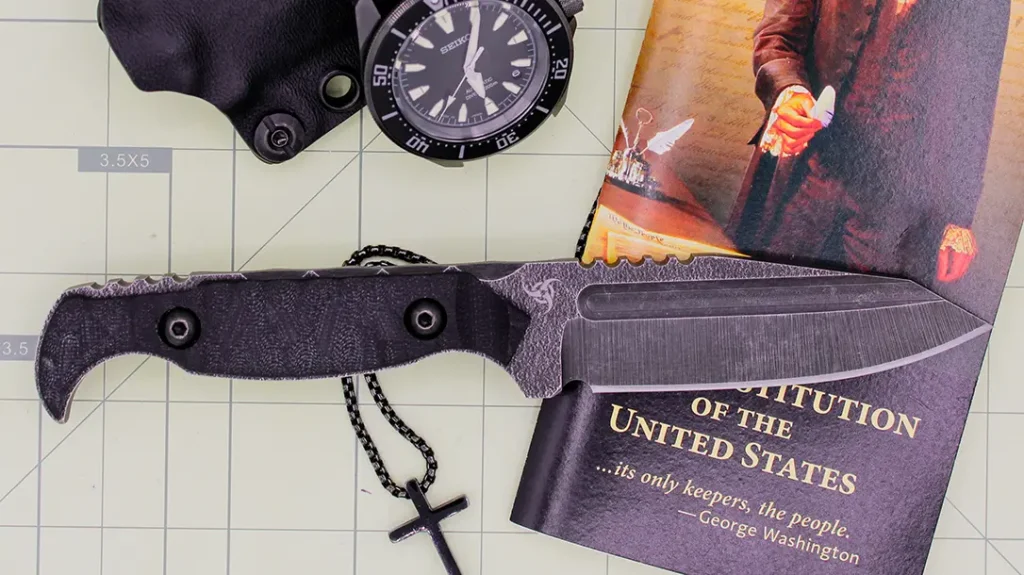
The next thing you notice is the weight of the blade. While not heavy, it isn’t featherlight. I’d describe it as well-balanced. The fulcrum is positioned just before the frontmost screw, giving the blade easy control.
Advertisement — Continue Reading Below
Apart from the blade’s thickness, which will be covered soon, you notice its shape. Alex described it as a modified sheep’s foot/Wharncliffe. It truly is a hybrid of both, with a descending point and a nearly straight edge taper.
But enough of first impressions, let’s move on to the knife’s specifications.
Specs & Steel
The RāDR is made from .230” thick 154CM steel. This is Brotherhood Blade’s most used steel for their production blades.
Advertisement — Continue Reading Below
When asked again why they chose 154CM, Alex stated, “Out of the very limited and carefully selected production steels we use, 154CM stainless steel hits the perfect balance — tough, sharp, and dependable. Originally engineered for jet turbines, it holds an edge, resists corrosion, and can be field sharpened with ease. No gimmicks, no hype — just proven steel for those who demand performance they can trust.”
BHB will use premium steel on its custom knives. However, for its price point, 154CM provides greater value to the end user, while still striking a balance of what people need.
Furthermore, the RāDR measures 7.5 inches in length with approximately 3.25 inches of cutting surface. The blade is hardened to 59-60 RC, balancing toughness and durability. Constructed of G10, the grip has a textured finish. The blade features a battle-worn finish that complements the G10. A BHB logo is etched on the right side, while the steel type is etched on the left.
Advertisement — Continue Reading Below
Fit & Form
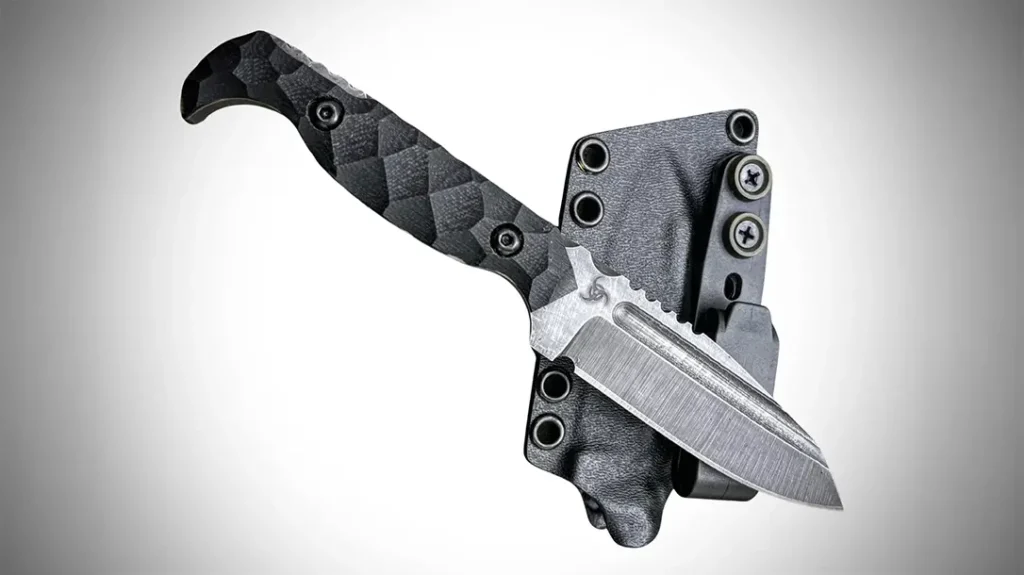
The RāDR is more than meets the eye (not quite like an Autobot. It won’t transform). The jimping on the spine is large and aggressive, ideal for control and force on hard surfaces. There’s even jimping further back toward the pommel for use in a reverse grip.
The grip itself has two finger grooves: one for the pointer and the other for the pinky. For me, it fits perfectly. But I don’t have large hands. It offers about 3.375 inches of usable grip space. For someone with larger hands, this could be an issue.
The pommel of the knife is described as the “noggin nob.” It curves around your pinky finger and provides protection, but it could also be used as a blunt force weapon. There is a Fuller, or blood groove, running the length of the blade as well. Finally, the RāDR, like all Brotherhood Blade knives, ships with a Kydex sheath made by Zero9 Holsters, a local company that caters to first responders.
With all that said, let’s see how the RāDR holds up in use.
Putting the RāDR to the Test
For testing, I thought we’d keep things festive. I still had some pumpkins lying around from the Halloween season. So, why not repurpose one?
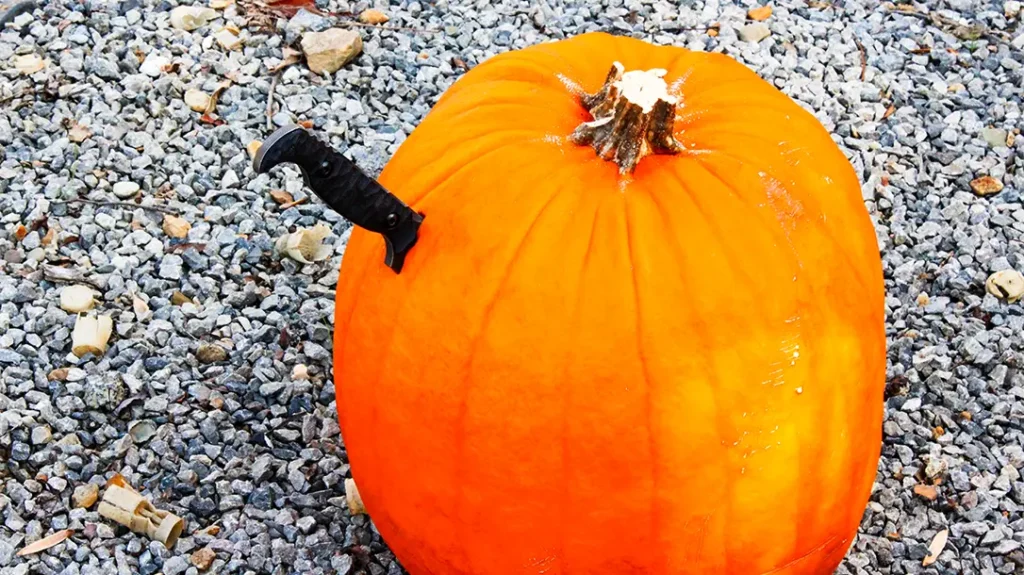
Unlike carving a Jack-O-Lantern, I wanted to see how the blade performed in both slicing and stabbing. As the supporting pictures show, the pumpkin proved no match for the RāDR. It easily sliced through the membrane, while stabs went the full length of the blade, onto the next.
Although I’m not a survivalist, I see this knife as a versatile tool that can be useful in many situations. One of those might be to whittle tree limbs into spears/gigs for emergency use, such as fishing or even hunting.
I didn’t have a tree limb on hand, but I did have a piece of 2×4 pine. Using short, choppy motions, the RāDR easily whittled down the board’s corners and could remove 1- to 2-inch chunks at a time. So far, so good.
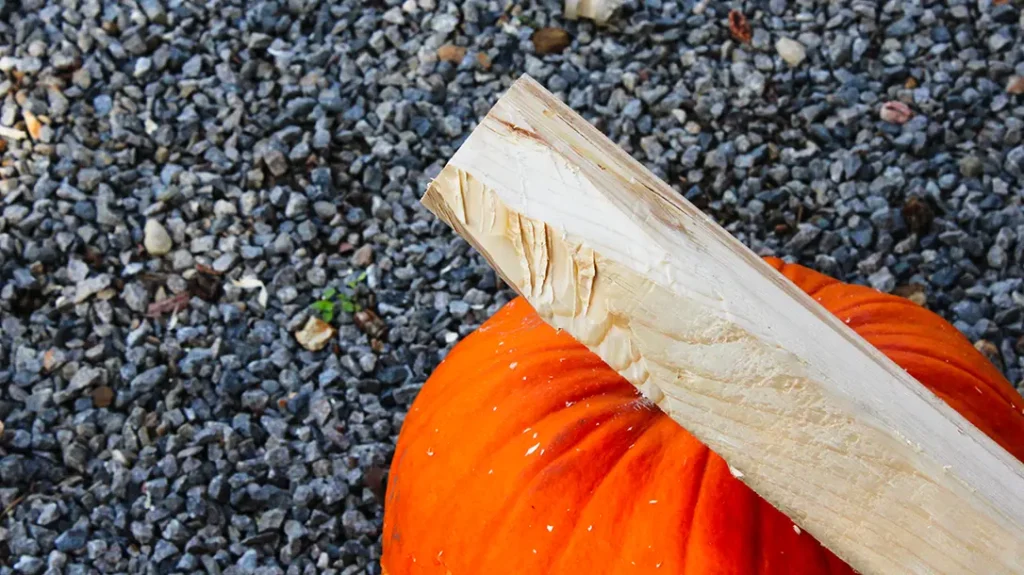
Before the next test, I threw the knife into the gravel and rubbed it around to see how the finish held up. And, yes, some scratches and scuffs appeared, but I believe they give the knife character.
This isn’t a knife meant to be a collector’s item. It’s a tool and should be used as such. The scars of use become the hard truth of endurance, carved by every blow it takes. It’s both a reflection of the knife’s quality and a symbol of the life of the person who wields it.
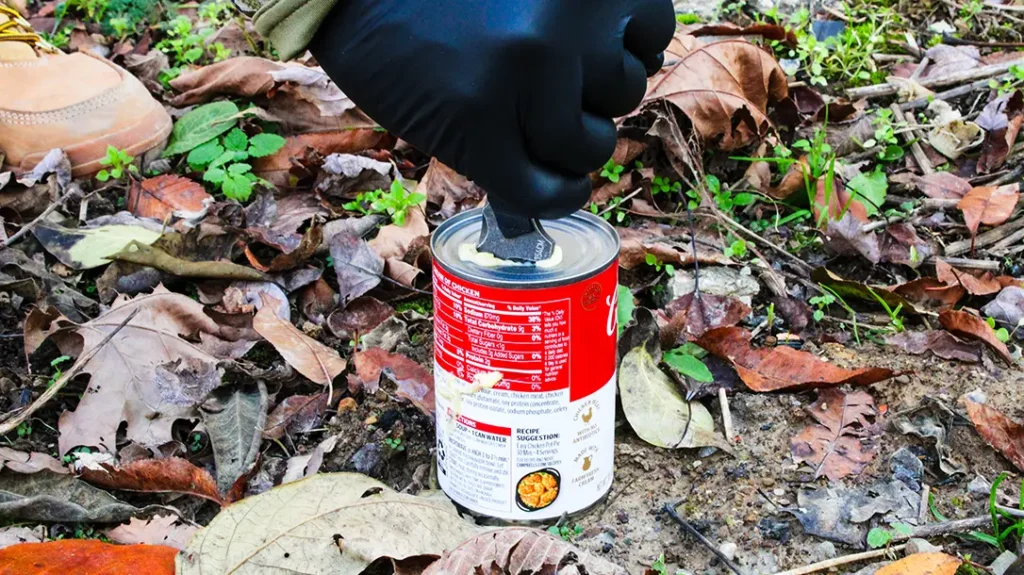
The next target was an expired can of Campbell’s Cream of Chicken. And, to no surprise, the can’s tin didn’t turn the blade. I easily punched through both the side and top of the can. The modified sheep’s foot and Wharncliffe offer plenty of flexibility for various needs.
Can It Continue?
So, after chopping a pumpkin, whittling a 2×4, taking out frustration on a can of Cream of Chicken, all while dragging the knife through a lot of gravel, what’s the final test? Any knife enthusiast knows that the great equalizer for a good blade is cardboard. The corrugated sheets of paper and glue can really wear down a knife blade.
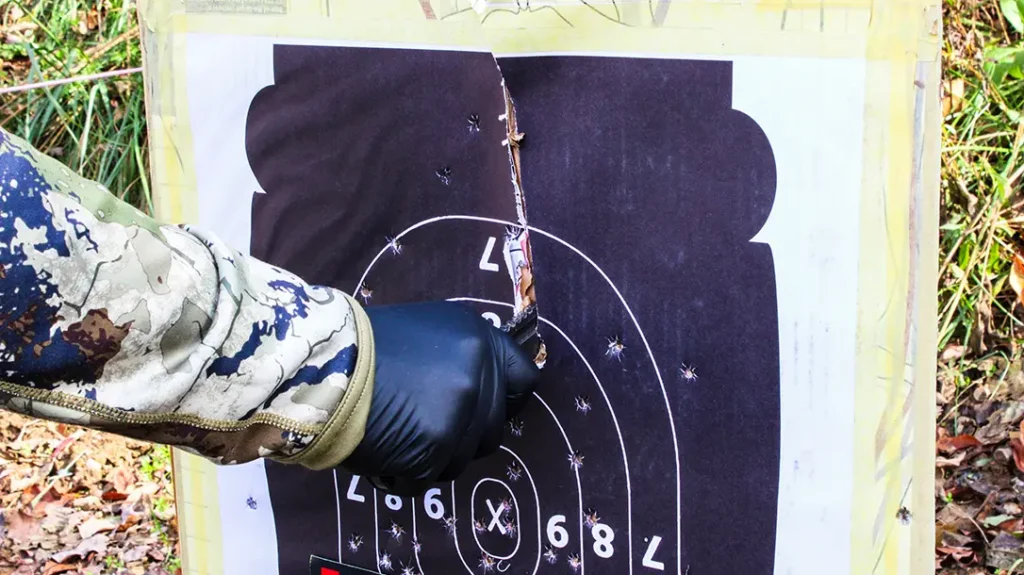
I had a leftover piece of thick cardboard from a recent trip to the range. I held it upright and, with a smooth slicing motion, cut through just over 8 inches of cardboard. To me, this proved that the knife can still perform even after rough use. This demonstrates both the skill of the knife maker and the quality of the materials used.
The RāDR in Carry
The final talking point is how the knife handles in everyday carry. When shipped, the RāDR comes with a Kydex sheath designed for a typical IWB with a belt. And for me, this didn’t work. I’m not a big guy, so no matter where I positioned it around my belt line, I couldn’t get comfortable, especially when adding a pistol and spare magazine to the mix.
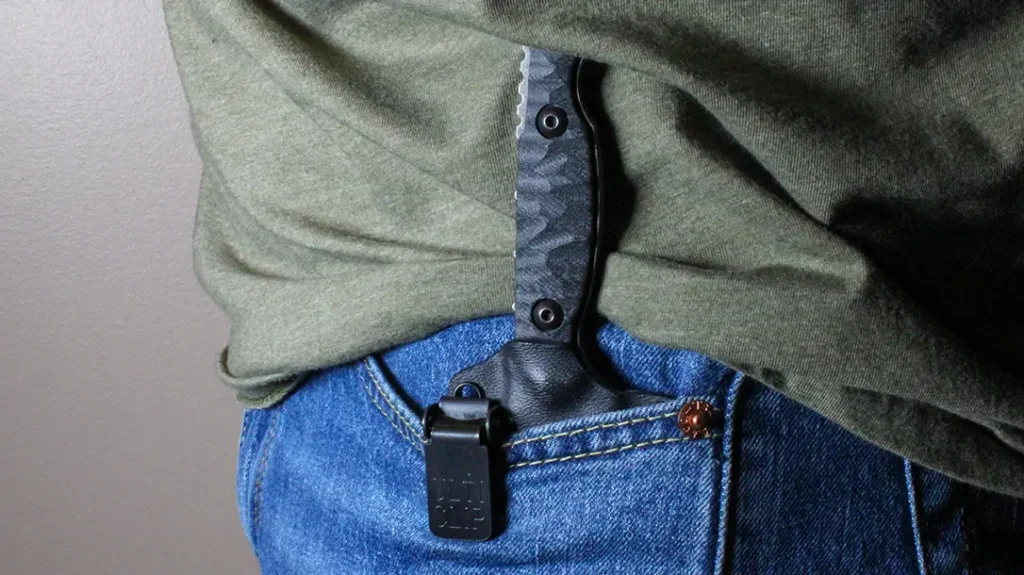
After talking with Alex, I ordered an UltiClip Slim 3.3. That was a game-changer. I now carry the knife in my left-side pocket. I am left-handed but shoot right-handed. So, this setup is perfect. It conceals easily under a shirt, but remains accessible, and with the UltiClip, the sheath stays in place when drawing the blade.
To the Point
Throughout my time with the Brotherhood Blades RāDR, I have been highly impressed with its quality, durability, and overall design. As I’ve learned more about the knife and the skilled hands that craft it, my admiration has only increased. I often find myself admiring the blade’s design and appearance. Many people I have handed it to shared that same opinion.
The blade retails for $249.99. While I wouldn’t call $250 cheap for something, I genuinely believe the RāDR is a bargain at that price.
WHY OUR ARTICLES/REVIEWS DO NOT HAVE AFFILIATE LINKS
Affiliate links create a financial incentive for writers to promote certain products, which can lead to biased recommendations. This blurs the line between genuine advice and marketing, reducing trust in the content.

