

Throughout history, firearms designs have failed. Some were poor designs while some were vastly ahead of their time but failed to overcome preconceived notions of the public. Some lacked the marketing horsepower to succeed. Some “looked good on paper” but failed to achieve full production status due to difficulties in executing the design. I suggest many of the most innovative developments in the advancement of small arms occurred between 1800 and 1900.
From black powder to smokeless, from flintlock to percussion caps, from rimfire to centerfire, from single-shot breechloader to lever-action repeater to gas-operated machine gun, from revolver to magazine-fed semi-autopistol. All of these advancements occurred between 1800 and 1900, often creating situations where the technology outdistanced designs. Let’s face it, gunpowder, cartridges and the basic operation of today’s firearms have not progressed significantly since the days our country was smack in the middle of its westward expansion. However, like the pioneers, many of these guns never made it when settling the West. Two of these were the Evans Lever-Action Rifle and the Spencer Repeating Rifle.
Firearms Designs Destained To Failure
Evans Lever Action
Evans lever-action rifles and carbines were oddly unique. Invented by Warren Evans, a dentist from Thomaston, Maine, approximately 12,200 were produced between 1873 and 1879 before the company filed for bankruptcy according to Flayderman’s Guide to Antique American Firearms, (though other sources estimate as many as 15,000).
Advertisement — Continue Reading Below
Like the Spencer, the design used a radial-block receiver and a magazine in the buttstock.However, the Evans used a helical magazine capable of holding up to 38 rounds (in the early model) with standard production models holding 34 or 28 rounds, depending upon the proprietary .44 Evans cartridge used. This distinction makes the Evans the highest-capacitylever-action rifle ever produced. It was also one of the contributing factors to the design’s demise.
The helical Archimedean screw-type magazine formed the spine of the stock. Rounds were loaded from the rear. Unlike the Spencer, the lever must be cycled to advance the round in the magazine before loading the next round. A fluted cartridge carrier rotated a quarter-turn each time the lever was operated. Upon firing a few rounds, each of the existing rounds must be cycled out as you load fresh ones to return to full capacity. If not, loading a new round also ejectsan unfired one and leaves an empty space between rounds in the magazine, which must be cycled through to get to the next live cartridge. Not the best solution during a firefight.
Advertisement — Continue Reading Below
Proprietary Cartridge
Another factor leading to its failure was the proprietary cartridge. They were rather anemic, particularly the .44 Short, when compared to others of the period. The .44 Evans Short had a 1-inch case and pushed a 220-grain projectile at roughly 850 fps. The .44 Evans Long utilized a 1.5-inch case and launched anywhere from a 275- to a 300-grain projectile at nearly1,200 fps and was only chambered in the New Model. The magazine capacity advantage over the Springfield Trapdoor in .45-70 was thus rendered relatively irrelevant at longer distances. Enough rifles were sold commercially to keep Winchester producing these cartridges until the early 1920s.
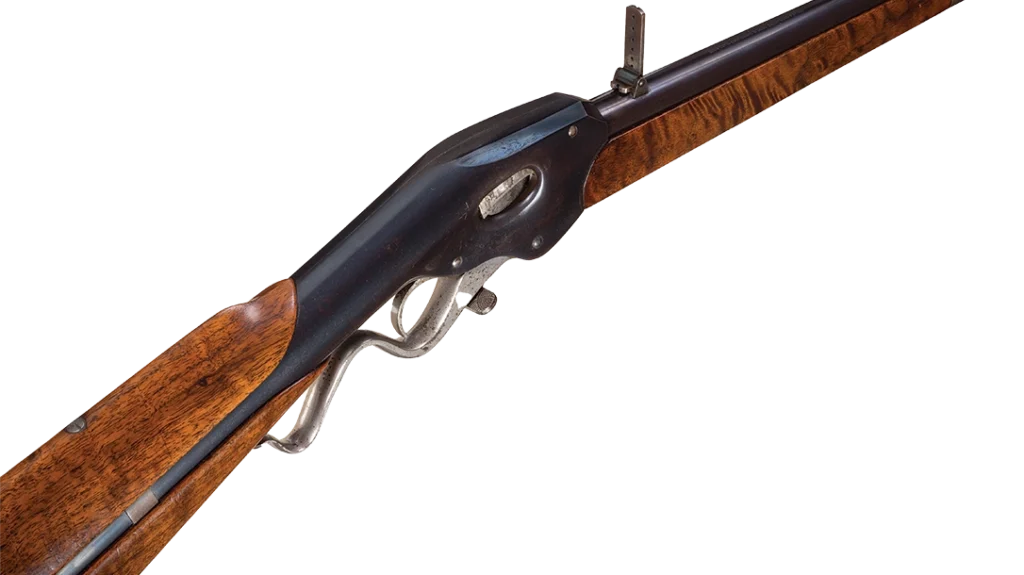
Finally, the rifle’s mechanism was fairly fragile and failed the standard dust test of the U.S. Army, relegating it forever to (limited) commercial sales in the United States, though the governments of Russia, Turkey and Peru all purchased versions of the rifles.
Advertisement — Continue Reading Below
Spencer Repeaters
The Spencer repeating rifle was designed by Christopher Spencer and patented in 1860. They were produced by both the Spencer Repeating Rifle Company and their subcontractor, Burnside Rifle Company, between 1862 and 1868. The Spencer was a lever-action repeater, housing seven cartridges in a tubular magazine located inside the buttstock. The first offerings were chambered in the proprietary .56-56 Spencer, which is a misnomer when compared to other cartridges at the time. The numbering system of cartridges such as .44-40 or .45-70 referred directly to the bullet diameter and the blackpowder charge. The numbers used in the .56-56 Spencer were the dimensions of the case at the base and the mouth. The actual bore dimensions for the military contract rifles are listed as .52 caliber, and all post-war Spencer rifles were officially listed as being chambered in either .56-50 or .56-52.
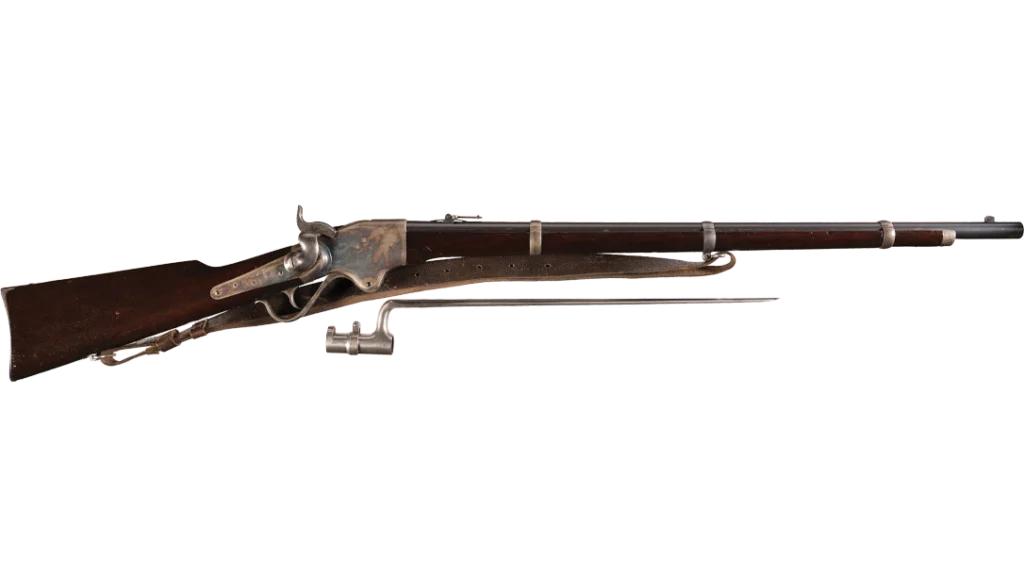
The Spencer had an additional benefit besides being one of the first metallic cartridge repeaters. It had the option to use “speedloaders.” And just when you thought speed loaders were a modern invention. The Blakeslee box held pre-loaded tubes of ammunition for the Spencer. The box contained 6, 10 or 13 tin tubes that held seven rounds each and was certainly an advantage for the Spencer.
Advertisement — Continue Reading Below
Spencer Downfall
It was difficult to label this rifle as a failure. Compared to the Evans repeating rifle, it was far more reliable and robust in design. It was adopted by Union forces during the Civil War. Total production numbers were significantly higher than the Evans with somewhere between 144,000 and 144,500 being produced according to Blue Book of Gun Values and Flayderman’s Guide to Antique Firearms, though two additional sources place total production at more than 200,000. It served admirably during the Civil War and beyond. Reproductions are being produced today. However, my reason for its inclusion was based upon several factors.
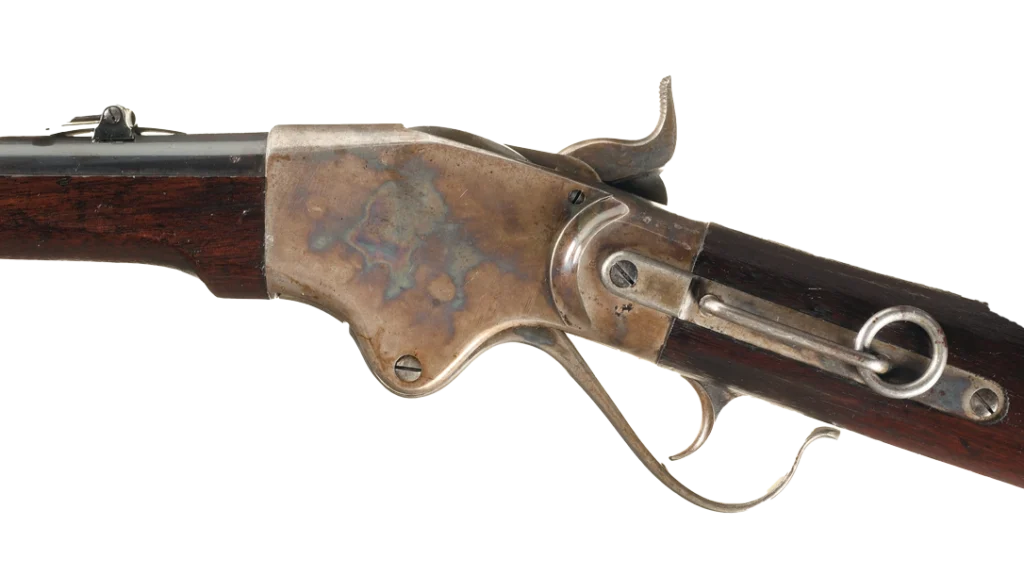
The first involves the mechanics of the system. To safely load a round into the chamber of a Spencer, the hammer must be placed in the half-cock position first. Lowering the lever accepts the next round from the magazine. Raising the lever then chambers it. Now the hammer can be cocked completely to fire. Once discharged, the hammer must again be half-cocked before extracting and levering the next round into the chamber. Granted this is faster than the Springfield muzzleloading musket of the time, but it also adds two additional steps when compared to cycling the 1860 Henry and the soon-to-follow 1866 Winchester.
Advertisement — Continue Reading Below
The second is the proprietary cartridge. With an overall case length of .875 inches and containing a powder charge of 42 to 45 grains of black powder, it is reputed to drive a 350– to 360-grain bullet at or near 1,200 fps. Not necessarily anemic for the period, but not as powerful as the 1861 Springfield musket or the British Pattern 1853 Enfield muzzleloaders.
Nail In The Coffin
Finally, the total production and usage of the Spencer during our westward expansion pale in comparison to Winchesters. There may be a good reason for this. When sagging Spencer sales forced them into bankruptcy, their assets were purchased by the Fogerty Rifle Company of Boston. Shortly thereafter, Fogerty went out of business and sold its assets to, as you might have guessed, Oliver Winchester. This included all future repeating rifle designs or improvements of one Christopher Spencer. Did Oliver Winchester kill Spencer? I guess we’ll never know.
WHY OUR ARTICLES/REVIEWS DO NOT HAVE AFFILIATE LINKS
Affiliate links create a financial incentive for writers to promote certain products, which can lead to biased recommendations. This blurs the line between genuine advice and marketing, reducing trust in the content.
Advertisement — Continue Reading Below

