

As impressive as gelatin tests look, what are we really seeing? Proper gelatin testing is complicated and represents a best-case-scenario performance measure. The basic problem is that the gelatin is homogeneous, and human bodies aren’t. We’re made up of muscle, sinew, fat, and bone of varying density, which can affect a bullet’s terminal performance. So, we decided to conduct a more realistic test by shooting deer meat with .380 ACP.
.380 ACP Deer Meat Test
In a real-world defensive shooting, the terminal performance of hollow points, many of which cost upwards of a dollar a round, can be dramatically changed when passing through clothing. Since most people wear clothing, that’s a pretty big deal.
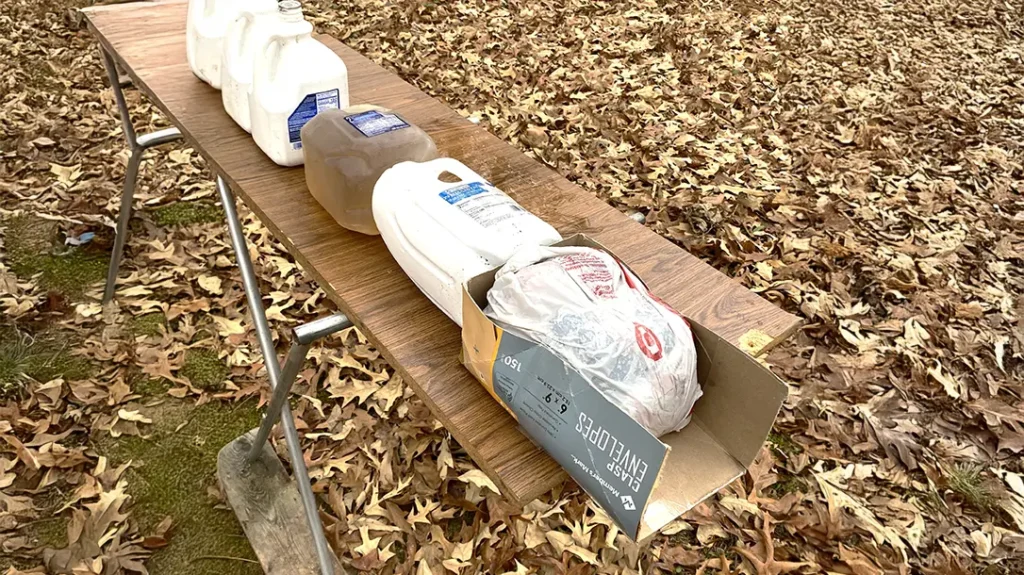
This is an evaluation of the performance of two respected brands of .380 ACP hollow-points through a tiny 2.75-inch barrel Kel-Tec P3AT pocket pistol. I tested them by firing into carefully prepared trays of deer flesh. These were backed up by plastic milk jugs of water to catch the bullets that penetrated completely through the flesh.
Advertisement — Continue Reading Below
Setting up the Test
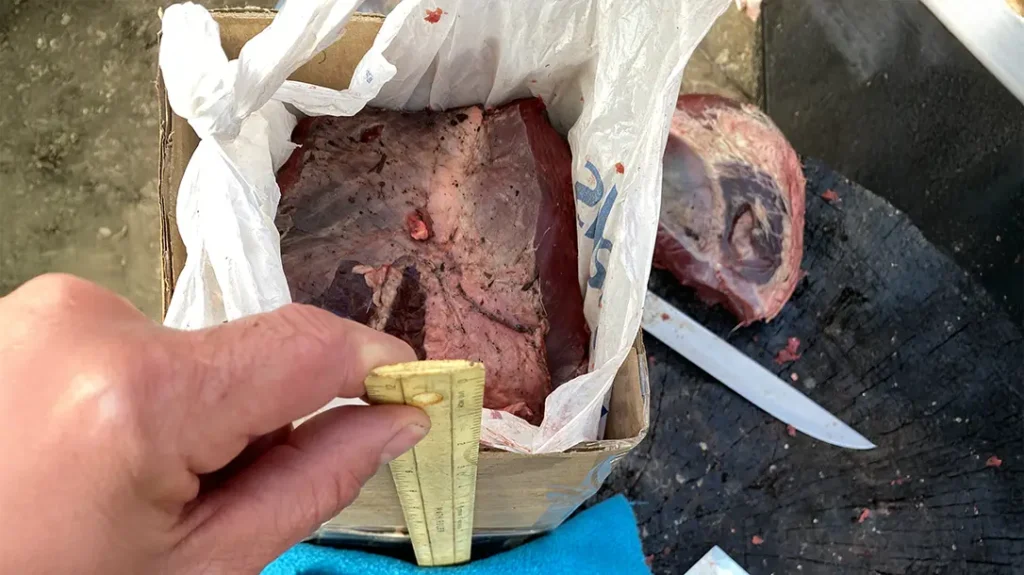
For each brand, I used the same test parameters. I created a flesh target approximating the thickness of a human abdomen by cutting up deer leg quarters into 2- to 4-inch-thick, 5 x 6-inch rectangles. These were layered 8 inches deep into an ordinary disposable plastic shopping bag.
The bag was held in a roughly rectangular shape by taping it inside a cardboard tray of the same dimensions with common plastic packing tape. The tray was closed at the back (exit side) but open at the front to expose the “skin” of the flesh target, consisting of a plastic bag covered by one layer of tape.
Advertisement — Continue Reading Below
I shot from the bench at a range of 17 feet over a chronograph. A magazine was loaded to capacity to test feeding reliability. Finally, taking careful aim, I spread out my shots and avoided hitting previously penetrated tissue.
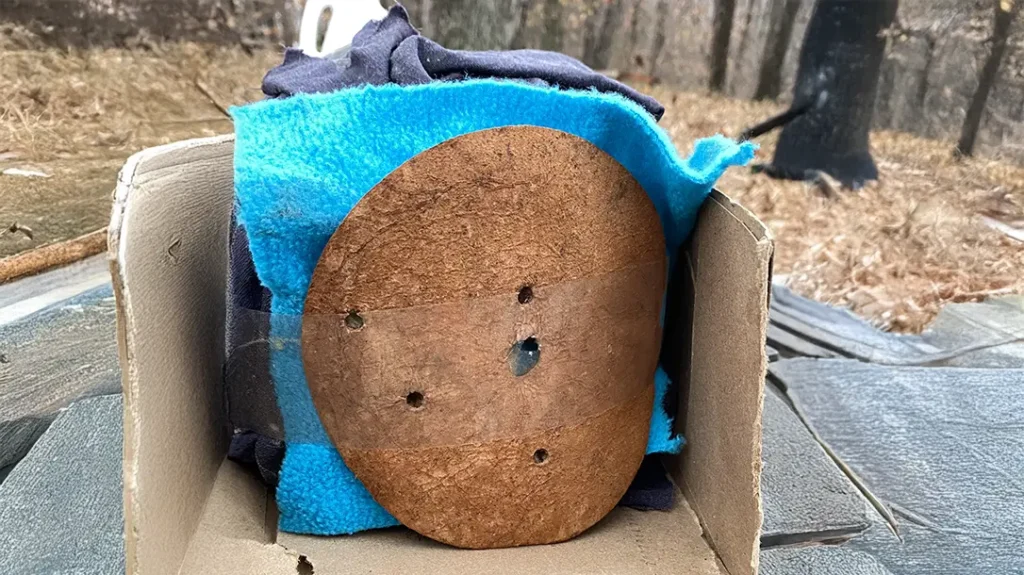
I fired directly through the plastic bag and packing tape “skin” to simulate a target with no clothing. Medium clothing was a layer of cotton twill shirt cloth .017 inch thick. That was covered with a layer of thick synthetic fleece commonly used in hoodies.
For heavy clothing, I added a layer of sheepskin leather, 0.055 to 0.075 inches thick, backed with wool. For the record, I also fired a five-shot group to test accuracy with each brand. A fresh block of flesh was used for each brand so I could dissect the tissue afterward and examine the wound channels.
Advertisement — Continue Reading Below
Federal Premium Personal Defense Low Recoil .380 ACP 90 Grain Hydra-Shok JHP
The Hydra-Shok bullet is famous for using a center post inside its deep (0.225 inch), tapered, cylindrical, hollow-point cavity. This directs the soft tissue forced into it sideways, pushing the sides outward and expanding the bullet.
In .380 the bullet has a truncated cone shape. Likewise, the copper jacket is partially cut through at six spots around the circumference of the cavity. This facilitates consistent breakage of the jacket into six petals during expansion.
Advertisement — Continue Reading Below
Advertised muzzle velocity is 1,000 feet-per-second (FPS) from a 3.75-inch barrel. From the 2.75-inch barrel P3AT, it averaged 882 FPS.
Results
Fired into the “unclothed” flesh, the Hydra-Shok bullet passed completely through and was captured in the first water jug. It looked like a catalog picture of perfect expansion, measuring 0.55 inches in diameter.
Through medium clothing (shirt & fleece hoodie), the bullet penetrated the flesh and was captured in the first water jug. It showed significantly less expansion (0.442 inch) of the lead core and uneven jacket expansion, with only four of the six sections petalled back. The cavity was partially clogged with shirt and fleece.
Advertisement — Continue Reading Below
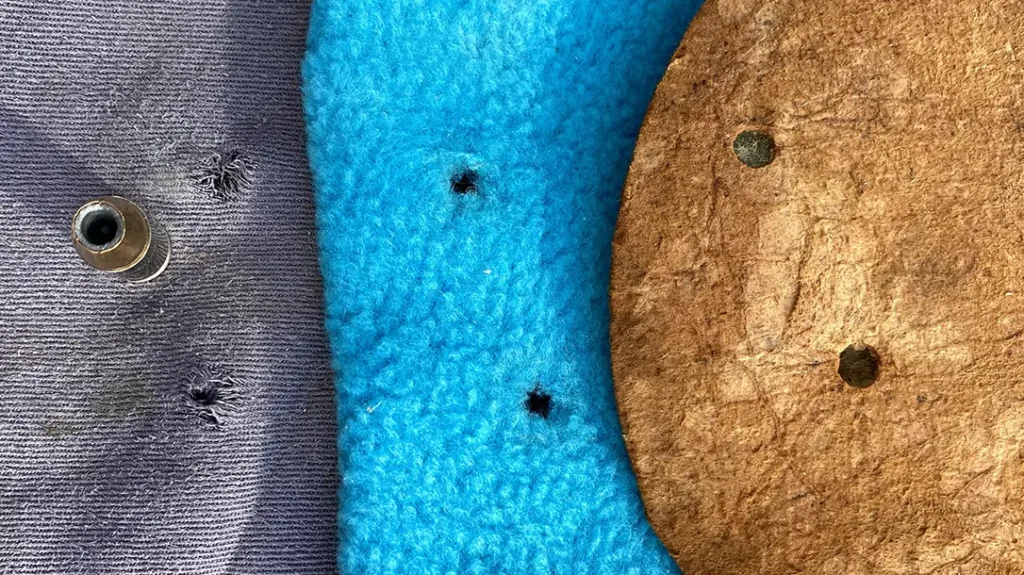
Through heavy clothing (shirt, fleece & leather), bullets passed completely through the flesh, and the first water jug. It was captured in the second water jug, showing little or no mouth deformation from expansion. I noted that the 0.024-inch open mouth of this bullet cut neat holes through the clothing materials, as if made with a punch.
The fabric and leather clogged the hollow-point cavity, preventing hydraulic expansion and effectively turning these into ball rounds. I found some of the punched-out discs of leather and fleece in the water jug.
This flesh target was the only one I left a bone in. As luck would have it, a bullet fired through heavy clothing passed through 6 inches of flesh and squarely hit the 1.25-inch-diameter leg bone at the rear of the tray.
Advertisement — Continue Reading Below
During dissection, I found the bullet inside the totally shattered bone. The impact actually cut through part of the jacket. Only the wound track of the first, fully expanded, bullet was noticeably larger than the other bullet tracks. Pieces of fleece, cloth, and sheep skin wool dragged into the wound were evident between the layers of flesh.
Hornady Critical Defense .380 Auto 90 Grain FTX JHP
Hornady’s patented Flex Tip FTX .380 hollow-point bullet is radically different from conventional hollow-points. It uses a flexible, rubbery plug to completely fill its totally concealed cylindrical cavity. You can’t see the cavity because the copper jacket’s nose is star-crimped over it, and the protruding plug leaves only the tip of the plug protruding at the front.
When the bullet hits soft tissue, the rubbery plug is compressed downward through the open parts of the jacket’s crimped nose into the cavity. This causes a simultaneous increase in lateral pressure, which expands the sides outward and begins to open the mouth of the cavity.
The crimping weakens the jacket so it will predictably break into six petals as the bullet expands. With its crimped nose, this bullet is unusually long and steep-sided for a truncated cone hollow-point. I noted in testing that the fully expanded FTX was smaller than the fully expanded Hydra-Shok. However, it had two important advantages over the conventional open-mouth hollow-point bullet.
The pointy FTX bullet chambered every time without fail, and it expanded much more reliably through clothing.
Advertised velocity was 1,000 FPS from the muzzle, but I measured an average of 853 FPS.
Results
Through “skin,” FTX bullets expanded fully, penetrating the flesh but not the water jugs. Expansion was perfect, measuring from 0.462 to 0.485 inches. Through medium clothing, five of seven bullets also fully expanded. The last two partially expanded, comparable to the best-performing Hydra-Shok, through the same clothing barrier.
Through heavy clothing, only one of four shots fully expanded, another showed the beginnings of expansion, and the last two showed none at all. Unexpanded bullets penetrated into the second water jug. The FTX bullet’s comparatively pointy nose made smaller holes through the clothing barriers than the Hydra-Shok. It showed no obvious evidence of the cavity packing at recovery.
Unexpanded bullets, and about half of the fully expanded ones, retained their rubbery plug. Disappointed, I tried another five shots through heavy clothing. This time, three expanded fully, and two didn’t at all.
During this experiment, my P3AT didn’t fully realize the performance promised in each brand’s impressive advertising claims. Both brands expanded beautifully against “unclothed” flesh. However, the conventional hollow-point clogged to some degree through medium clothing. This seriously reduced expansion, and a shearling coat turned them into ball ammo!
The unique Hornady FTX bullet expanded well, though not consistently, against medium clothing. The FTX was unpredictable through heavy clothing, too, fully expanding four out of nine times. It begs the question of why three of the nine shots didn’t expand at all.
.380 ACP Velocity
Part of the hollow-point performance shortfall I observed is likely due to inadequate velocity. My velocities were 147 FPS lower than advertised for Hornady FTX and 118 FPS lower for Federal Premium Hydra-Shok. The .380 is already on the low end of power, so it doesn’t have excess velocity to give up. However, in this case, I needed to match the gun to the ammo.
The highly concealable P3AT has a 2.75-inch barrel. Only 2 inches of that is throat and rifling, making it akin to a snubnose revolver. The ammo might have done better with a 4-inch barrel Beretta 84 or Taurus 58.
However, velocity is not the whole issue. Testing showed that bullets passing through the flesh didn’t always track a laser-straight path. In fact, sometimes they diverged so much that they missed the water jugs.
That’s an example of the unpredictability of shooting through actual flesh. It’s more pronounced with relatively low-power cartridges like the .380. Changes in tissue type and density can affect a bullet’s path. Why not expansion too?
Final Thoughts
A sometime advantage is better than no advantage. Understanding the limitations of your hollow-point ammunition allows you to make better practical use of it. If you live in a cold climate where the hoodlums dress heavily, your .380 hollow-points can’t be expected to perform as well as they would against the miscreants in warmer areas wearing shirtsleeves or less.
The question is, how much performance degradation is there? When in doubt, test it out. I didn’t find the Hornady FTX to expand as large as the conventional hollow point. However, in the tiny P3AT, it seemed to expand more often through medium- and heavy-clothing barriers.
I live in an area where medium-to-heavy clothing is the norm, except in summer. So, I’ll be using the FTX for three quarters of the year and Hydra-Shok in summer or on any occasion I happen to be at a nudist colony.
WHY OUR ARTICLES/REVIEWS DO NOT HAVE AFFILIATE LINKS
Affiliate links create a financial incentive for writers to promote certain products, which can lead to biased recommendations. This blurs the line between genuine advice and marketing, reducing trust in the content.

