

Proper knife sharpening helps protect the long‑term condition of the blade. When knives are allowed to become excessively dull, users often apply improper force, which can damage the blade’s edge. Regular sharpening maintains the blade’s shape and performance. So, how do we acquire and apply knife-sharpening skills? Glad you asked.
Old School
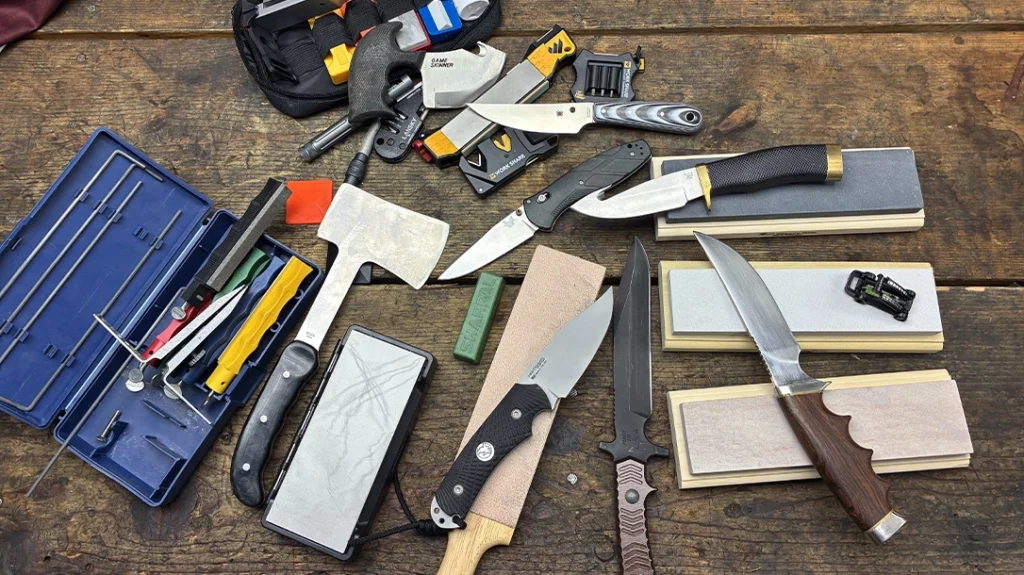
My grandfather used a combination of various whetstones and strops to hone our hunting blades to razor sharpness. The first evening after arriving at deer camp, everyone would hand over their hunting knives to Pap for inspection and touch-up. He would break out a variety of whetstones, honing rods, and strops for use by the fireplace and lanterns. After deer camp, there was little hair left on his arms as he tested his handiwork. It didn’t help that most would bring multiple blades for his inspection and improvement.
Whetstones are still one of the most respected and versatile methods for sharpening hunting knives. I try to follow my grandfather’s lead with various Arkansas whetstones. These are made from novaculite. Novaculite is a highly durable, silica-rich rock formed from ancient marine sediments, prized for its hardness and fine-grained texture found in the Ouachita Mountains in Arkansas (i.e., Arkansas whetstones) as well as Oklahoma and Texas. It is mostly silica in the form of quartz, giving it a very hard and dense structure. It typically appears white, gray, black, or occasionally pink or red, and is translucent along thin edges.
Whetstones allow full control over the edge angle and finish, making them suitable for both carbon steel and modern stainless hunting blades. Many hunters favor whetstones because they can restore severely dulled or damaged edges and tailor the edge for durability rather than extreme thinness. Whetstones do require skill acquired through patient, diligent practice. A stable surface is important to maintain the edge angle. You don’t want to be wrestling with a whetstone, keeping it steady as you draw your blade across it. Whetstones come in various grit levels, so you can use them according to your sharpening needs.
Advertisement — Continue Reading Below
The Sharper The Better
Unlike kitchen knives, hunting knives must handle hide, cartilage, bone contact, and abrasive contaminants such as dirt and hair. Effective sharpening techniques focus not only on sharpness but also on durability and control. For hunting knives, the goal is to create an edge that is sharp enough to slice cleanly while remaining strong enough to withstand hard use. Inconsistent angles lead to uneven bevels, weak spots, and faster dulling.
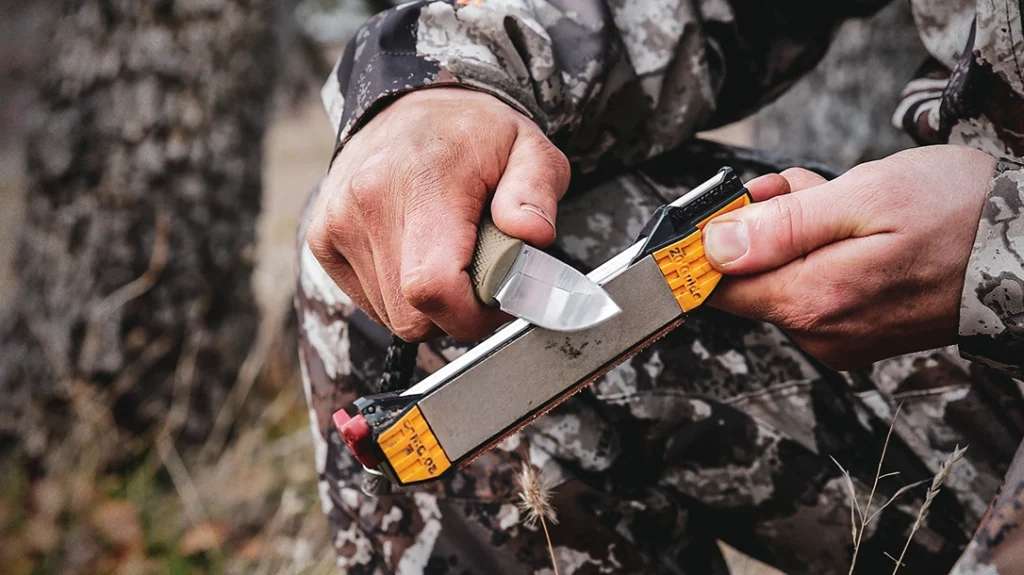
One of the most important sharpening techniques is maintaining a consistent edge angle. Regardless of method, consistency matters more than perfection. A steady angle produces a stronger and more predictable edge than one that fluctuates stroke to stroke. Experienced sharpeners develop muscle memory to hold a steady angle, while others rely on visual reference points or angle guides.
Guided Systems
The importance of edge angle control during sharpening is the reason guided systems are so popular. These systems are for those who want repeatable results without relying on freehand technique. By removing angle guesswork, guided systems help preserve blade geometry and reduce uneven wear, especially on harder modern steels.
The angle depends on the knife’s purpose. For example, 15-16 degree angles (per side) are found on Asian kitchen knives or fillet blades. The edge is thin, but razor sharp. 18-20 degree edge angles, everyday carry knives balancing sharpness and durability. 20-22 degrees is where most hunting knives find themselves with edge angles providing a stronger, more lasting edge profile. Lastly, heavy-duty tactical blades that lean toward toughness over razor sharpness are in the 25-30 degree angle.
Advertisement — Continue Reading Below
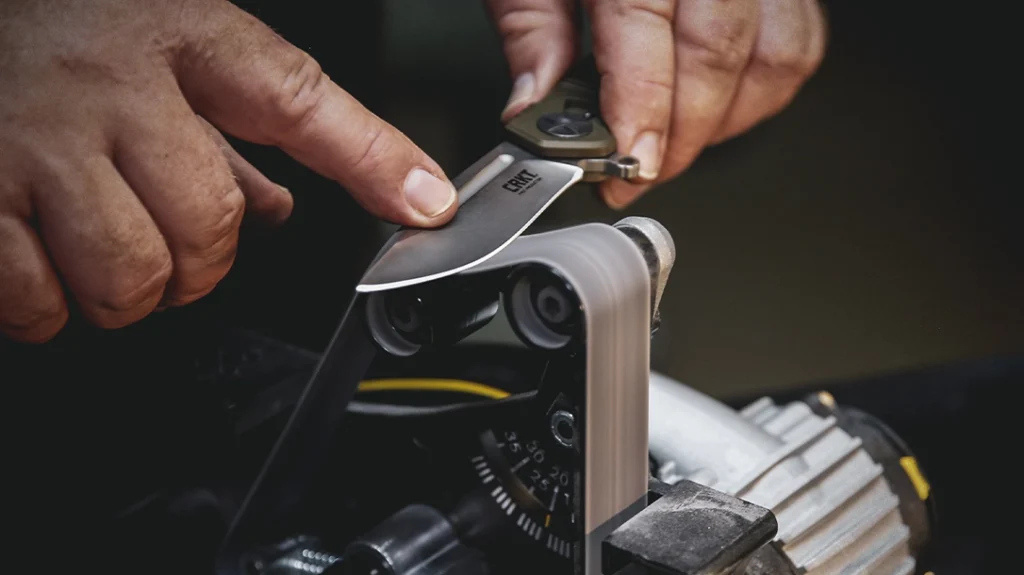
Guided sharpening systems use clamps or angle guides to maintain a consistent edge angle throughout the sharpening process. Most guided systems are designed for home or workshop use rather than the field. They are often praised for precision and consistency, making them a preferred choice for hunters who maintain multiple knives or premium blades.
Pull Through
In the honorable mention category come pull-through sharpeners. These are easily carried in a pocket or day pack. If there is a “fire and forget” class of sharpeners, pull-through sharpeners are it. Lightweight configurations with abrasives angled in place for you to drag your blade through, offering fast sharpening with minimal effort. The hunter who realizes the importance of blade sharpness, without wanting to bring along whetstones, will have a pull-through. With that said, pull‑through sharpeners are best used sparingly and primarily in the field rather than for regular maintenance of high‑quality knives. For example, you have an elk or moose down in the back country where quartering out is the only option, your knife had better stay sharp.
Edge Refinement
Your work is not done after getting the proper angle to come together with your blade. No matter the method chosen for moving metal to create a sharp edge, a final touch involving honing and/or stropping is critical. Honing and stropping can also be used to maintain a sharp edge longer.
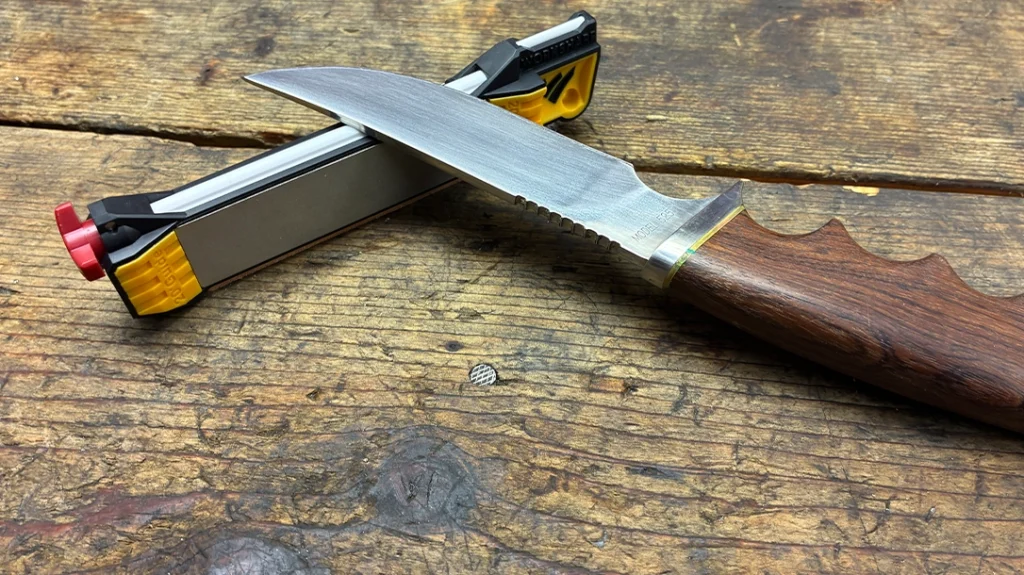
Honing is the process that follows sharpening, using a finer stone to refine the edge and smooth out the “roughness” caused by the coarser stones used in the sharpening process. Think of it as good blade geometry insurance. I have come to prefer ceramic “stones” for my honing. However, steel can be used. We have all seen a famous chef working a knife back and forth in front of themselves on a steel rod. That is honing. It is encouraged to hone your blade in between sharpening as a way to refresh and maintain a sharp edge.
Advertisement — Continue Reading Below
Stropping is for refining edges after stone (or diamond) sharpening, helping improve cutting efficiency without sacrificing durability. Stropping a knife is often the final process of polishing a knife and removing any remaining imperfections or irregularities that may be left over after the sharpening or honing process. When a knife is sharpened, a “wire” edge is created, also known as a burr. The honing process works to eliminate the burr. However, microscopic inconsistencies can remain – this is where stropping comes in.
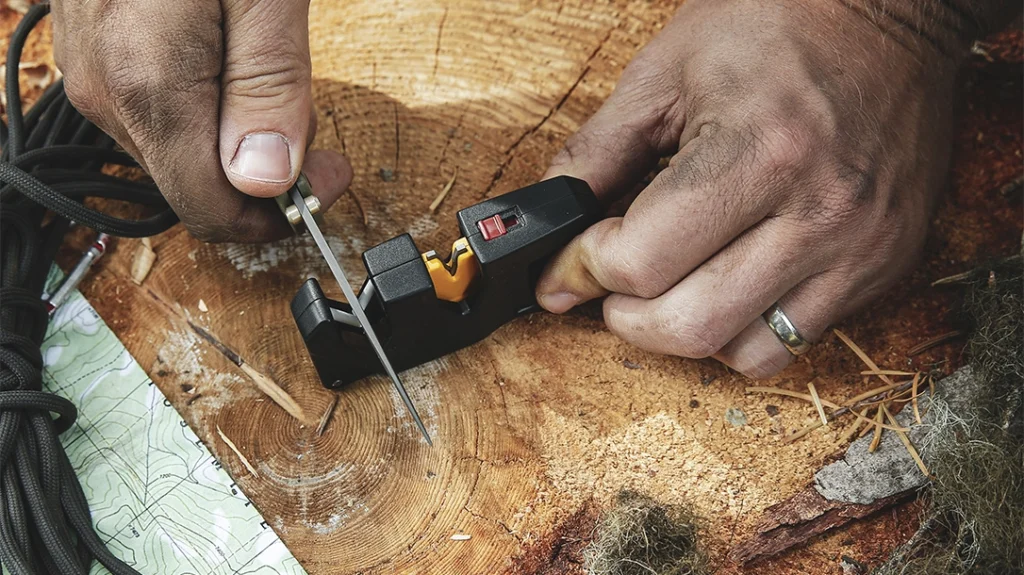
Honing and stropping methods extend edge life and reduce the frequency of full sharpening sessions, making them an important complement to primary sharpening techniques.
Conclusion
This article is intended to be more as a primer to get some thought generated on the topic of knife sharpening, rather than a comprehensive guide. A few hundred words do not do the topic justice. The same length could be used to discuss various grit levels, diamond abrasive stones versus whetstones, the importance of stroke technique when drawing steel across your sharpening medium, pressure control when sharpening, alternating sides, powered tool-assisted sharpening methods, and so on. They are all worthy of more in-depth study. Think of it as homework for the reader.
Advertisement — Continue Reading Below
Like many subjects at the intersection of art and science, a flexible approach to sharpening your blade is most effective. Seasoned hunters typically employ a variety of techniques, combining edge restoration at home with in-field maintenance, to ensure their knives deliver consistent and dependable performance when required.
WHY OUR ARTICLES/REVIEWS DO NOT HAVE AFFILIATE LINKS
Affiliate links create a financial incentive for writers to promote certain products, which can lead to biased recommendations. This blurs the line between genuine advice and marketing, reducing trust in the content.

