
For new rifle owners looking to get a riflescope for easier aiming and better accuracy at longer ranges, the nomenclature can be quite confusing. Just look up any riflescope description on the internet, and unless you know what you’re reading about, it might as well be in another language.
Take heart: Once you know what all the optics-centric words mean, any riflescope description will make sense to you. Today, we’ll define 15 commonly used terms that might not make sense if you aren’t familiar with them.
Riflescope Terminology
Coatings
The optical elements within a scope are coated to alleviate internal light loss and glare. That ensures even light transmission, resulting in greater image sharpness, brightness, color fidelity and contrast. From least effective to best, they are coated, fully coated, multicoated and fully multicoated.
Advertisement — Continue Reading Below
Exit Pupil
This is the diameter of the beam of light that leaves the eyepiece of a riflescope, measured in millimeters. The larger the exit pupil, the brighter the image will be—an important factor for low-light shooting.
Eye Relief
This is the distance from the rear lens of a riflescope to the point at which the user’s eye can see the full field of view. More eye relief means less chance of whacking yourself in the forehead with the scope during recoil.
Field Of View
FOV is the size of the area that can be seen when looking through a riflescope. It is typically measured in the number of feet that can be viewed at 100 yards. The higher the magnification, the smaller the field of view.
Advertisement — Continue Reading Below
Light Transmission
A scope’s ability to transmit light is crucial for how well a distant object can be seen through the scope. Several factors can affect light transmission and, as a result, image quality, including lens glass quality, coatings used and the lens diameter.
Magnification
The extent to which an object appears enlarged is called magnification. For instance, with a 3-9x riflescope, you can magnify the target from three times to nine times its normal size. Keep in mind that increasing the power reduces the brightness of the image.
Advertisement — Continue Reading Below
Minute Of Angle
Also called MOA, it is a unit of measurement for a circle, equivalent to 1.0472 inches at 100 yards (or about 1 inch at 100 yards for practical use). Therefore, it is approximately 2 inches at 200 yards, 3 inches at 300 yards, and so on.
Objective Lens
The objective lens is the front lens on the riflescope, usually measured in millimeters. For a 3-9×42 scope, it would be 42mm, while the magnification ranges from three to nine times. A larger objective lens allows more light to pass through, resulting in clearer images, while a smaller one transmits less light.
Ocular Lens
Also known as the eyepiece lens, this is the lens closest to the shooter’s eye. It is smaller than the objective lens and adjustable for focus to an individual user’s eyesight. The exit pupil is emitted from this lens.
Advertisement — Continue Reading Below
Parallax
Parallax is when the reticle and the target are on different focal planes, and is the reason you can’t focus your eye on a distant object and close one at the same time. This is most noticeable when the eye is moved off of dead center when looking into the scope. If you move your eye a little off center and the crosshair remains on the same position of the target, you are said to be “parallax free.”
Resolution
This is a measurement of the scope’s ability to distinguish fine detail and produce sharp images. Resolution is closely linked to the size of the objective lens, as larger lenses allow more light, resulting in a clearer sight picture. Higher resolution also benefits from better glass and coatings.
Advertisement — Continue Reading Below
Reticle
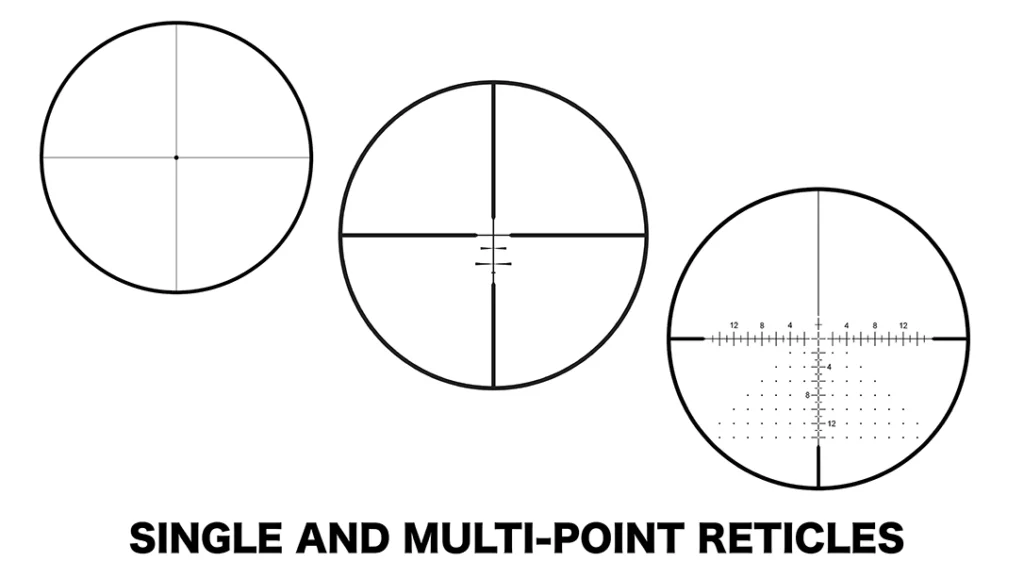
The reticle is the crosshairs or aiming point in the riflescope that you align with the target when pulling the trigger. A few decades ago, most were simple crosshairs. However, today they range from basic crosshairs to tactical reticles, precision reticles and everything in between.
Tube Diameter
This, of course, is the diameter of the scope’s main tube. Common sizes are 1 inch, 30mm and 34mm. A larger tube diameter provides a greater elevation adjustment range, which is essential for long-range shooting.
Turret
The turrets are the knobs located on the center of the scope tube. The one on the right adjusts the windage (left and right), while the top one adjusts the shot’s elevation (up and down). These are used during sighting to ensure the rifle shoots exactly where the reticle is aimed.
Advertisement — Continue Reading Below
Zero
This is simply the distance at which your scope is sighted in. If you sighted it at 200 yards, you have a 200-yard zero, meaning your bullet will hit the center of the target at 200 yards.

