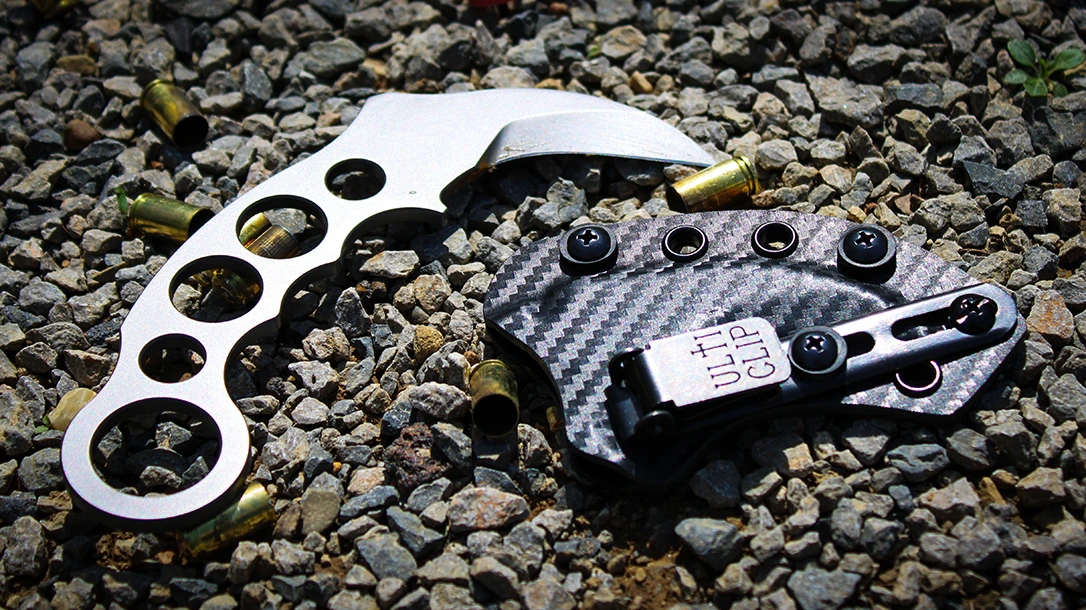
There are knives we own that might bring us intrinsic joy, but at the end of the day, they serve a purpose. They are tools. Form and function will vary from model to model, but beneath it all, a knife is a tool designed to perform a simple task. The Karambit is a design with roots in agriculture that made its move into combat. Steve Tarani and High Desert Blade Works keep the Karambit tradition alive with the Tarani AR15 Karambit.
The High Desert Blade Works Tarani AR15 Karambit
However, knife tasks vary. Most of the time, that task is utilitarian. Sometimes, it’s for work or a particular profession, and other times it’s for self‑defense. After all, isn’t that one of the oldest uses of edged weapons—to give you an advantage over an opponent?
Advertisement — Continue Reading Below
While knife design and manufacturing techniques have changed over the centuries since humans first knapped flint and obsidian, the basic principles remain the same. The Karambit is an ancient agricultural blade that has excelled in self‑defense.
What’s a Karambit?
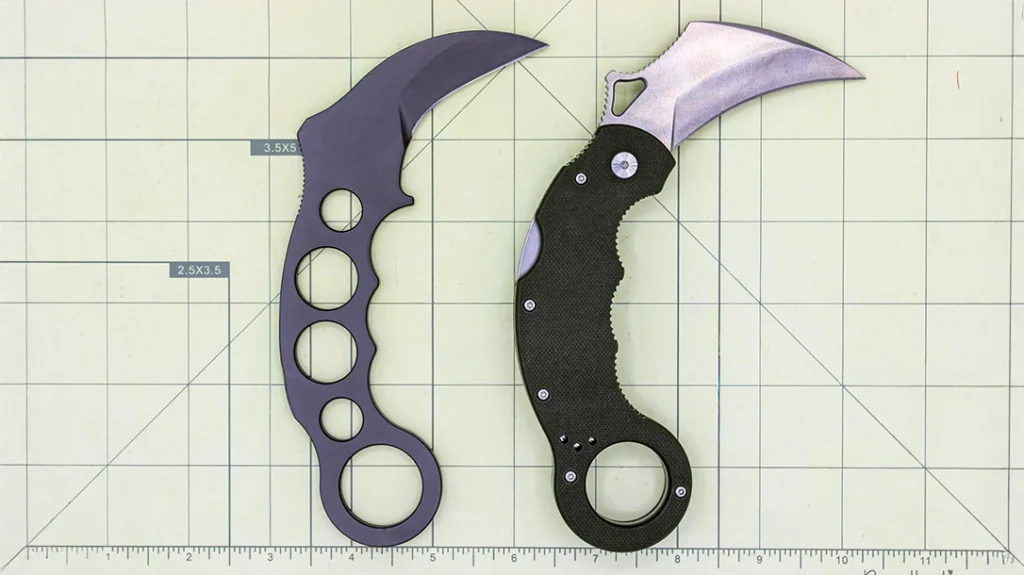
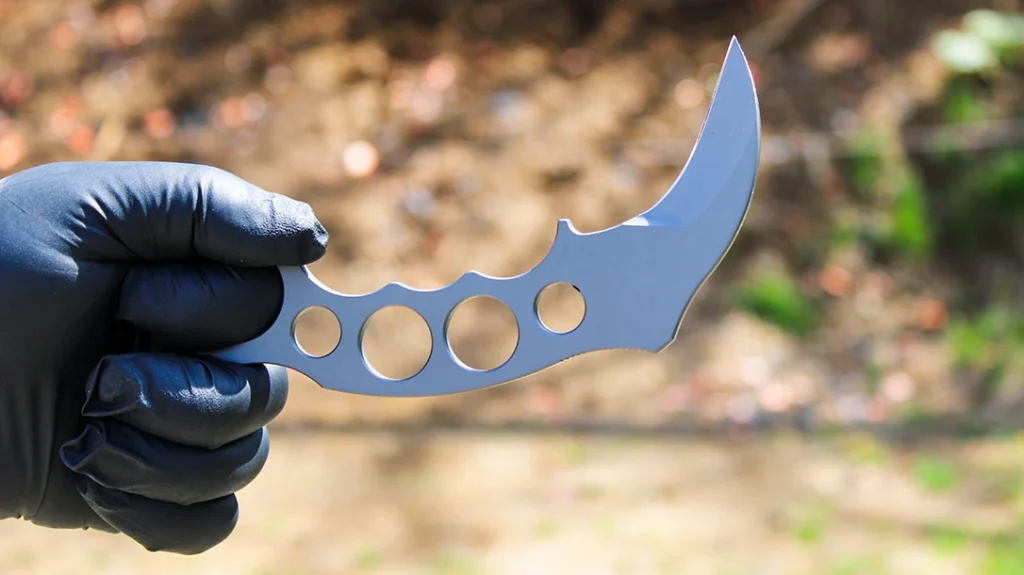
At its core, the Karambit is a compact, curved blade distinguished by its claw-like profile and a retention ring on the handle. According to oral history passed down through Indonesian martial traditions, its design dates back to regions such as Sumatra, Java, and Malaysia, where agricultural tools often doubled as defensive implements.
Advertisement — Continue Reading Below
Over time, regional variations emerged, but the defining characteristics remained consistent. It has a sweeping curve optimized for hooking, ripping, and maintaining control in close quarters.
Early Javanese bladesmiths are said to have drawn direct inspiration from the tiger’s claw—an efficient natural design built for grip and tearing power. That influence remains evident today.
The curvature enhances cutting mechanics and helps the blade stay engaged upon contact. Paired with the finger ring, which improves retention and indexing under stress, the karambit becomes a tool focused on control, leverage, and fluid motion. It is a design that has endured for its effectiveness.
Advertisement — Continue Reading Below
Who Is High Desert Blade Works and Steve Tarani?
High Desert Blade Works (HDBW) was founded with a straightforward goal. Specifically, bring practical, well-built knives back into focus in a market crowded with options.
The company grew out of post-COVID conversations between Thomas Gomez and knife designer Steve Tarani. Their idea was simple: revive proven designs and develop new tools that emphasize durability, function, and real-world performance. Gomez brings experience in precision shooting, training, and consulting. Likewise, Tarani contributes decades of experience in defense, law enforcement, and edged-weapon design.
Advertisement — Continue Reading Below
With additional input from industry figures like Duane Dwyer, HDBW quickly moved from concept to production. The result is a brand focused on straightforward, purpose-driven tools built to withstand hard use.
The Tarani AR15 Karambit
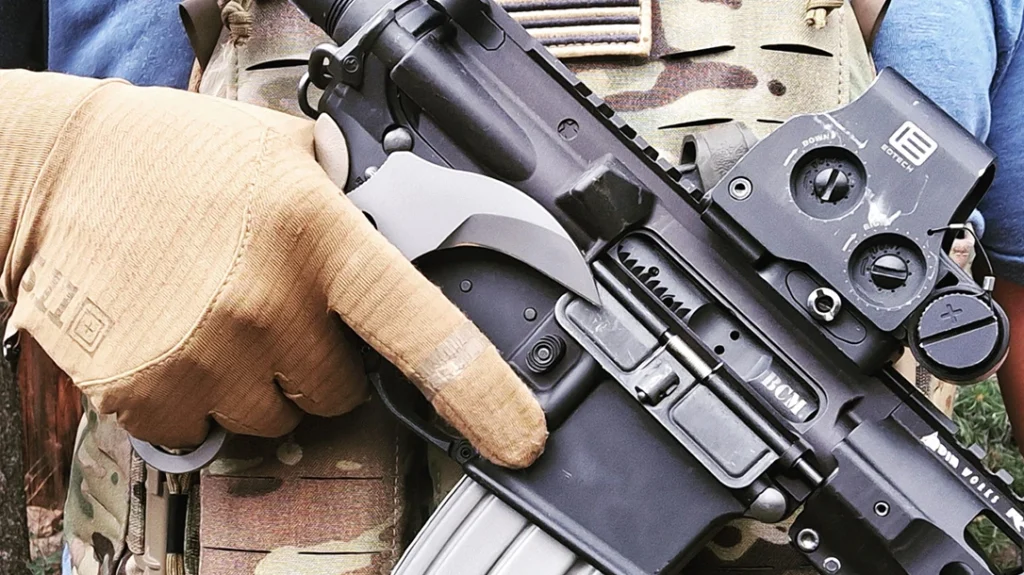
This knife has a unique design compared to others. Its thick blade is intended more for punching than for the typical slicing action of a karambit. I asked Thomas Gomez about the reasoning behind this product. He explained that the knife was originally designed by Duane Dwyer and Steve Tarani in the mid-2000s for Delta Force and other special operations users.
Advertisement — Continue Reading Below
They needed a way to carry a blade effectively in confined spaces, while also managing and controlling crowds.
The blade is meant to be held in your dominant hand and indexed off an AR-15’s receiver (hence the name, AR15 Karambit). Because of the blade’s design, a user can maintain proper control of the rifle while holding the blade. This knife was intended for a specific use. However, that doesn’t mean it’s any less of a defensive weapon for the rest of us.
Specs & Discussion on Steel
Out of the box, the Tarani AR15 Karambit arrives as a complete package. It ships in a nylon pouch with a Velcro patch. Inside, you’ll find a molded Kydex sheath, an UltiClip for mounting to a belt, waistband, MOLLE, or pack, and a breakaway lanyard for neck carry. It’s a functional setup that doesn’t require any extra tweaking.
Advertisement — Continue Reading Below
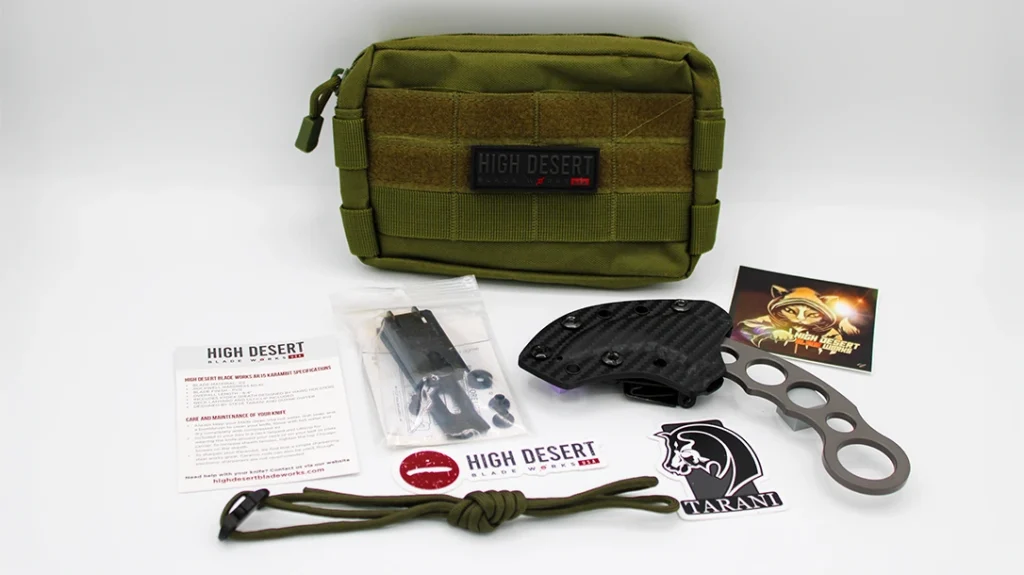
The knife itself keeps things simple. The blade is made from D2 tool steel, heat-treated to around 60–61 HRC, and finished in either black or grey PVD. At just over 2 inches long, with an overall length of about 6.4 inches and a weight of about 3.9 ounces, it’s compact and easy to carry.
D2 sits between carbon and stainless steel. It’s known for strong edge retention and wear resistance, which were clearly evident in testing. It held its edge well even after repeated abuse. The trade-off is that it isn’t fully stainless. So, it benefits from a little maintenance if exposed to moisture or subjected to hard field use.
What stands out most, though, is how it feels in the hand. The grip provides a solid purchase with well-placed finger grooves, and the retention ring keeps everything secure. It feels secure and predictable, which matters more than anything in a tool like this.
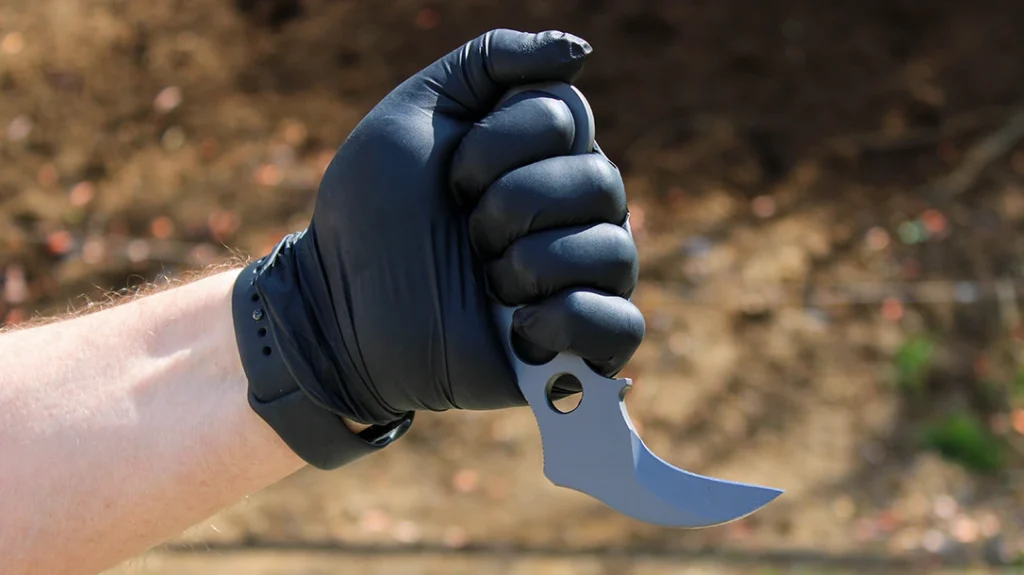
What sets it apart is how it handles. The grip is designed to give you a solid purchase, with comfortable finger grooves and a ring that helps keep everything locked in place. It feels natural and balanced in your hand, whether you’re doing basic tasks or more delicate work.
Testing the AR15
Like other knife tests I’ve conducted, I pitted the AR15 against a number of worthy foes. Because this knife is designed for a more specific purpose, it didn’t perform as well in certain areas. But that is to be expected.
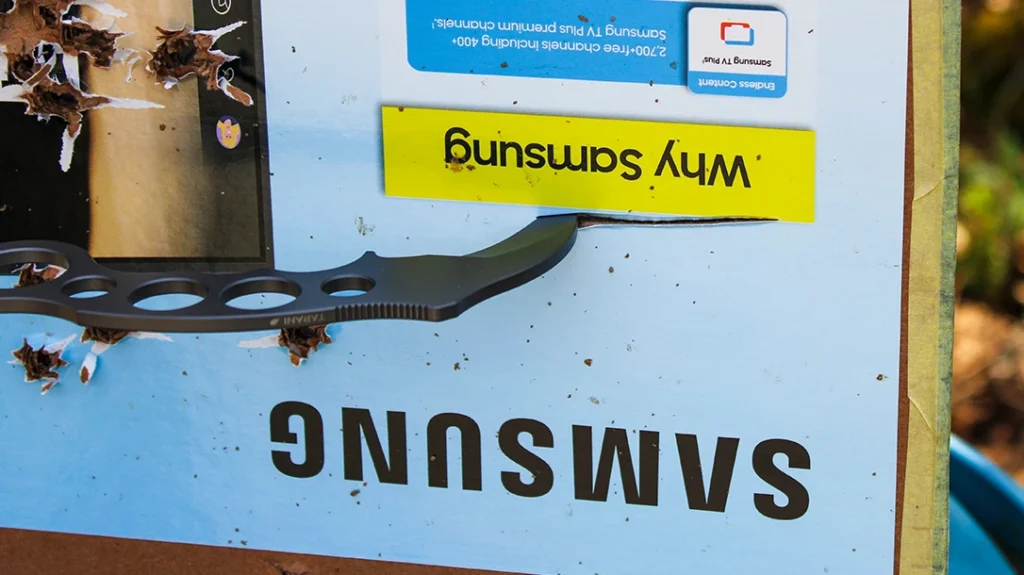
For instance, it wasn’t great at slicing through cardboard. As you can see in the accompanying photos, it only cuts through a couple of inches before stopping. Again, this uses a thick blade (4.4mm) and is designed for punching with the blade up. With that, punching through cardboard was easy.
Next up is everyone’s favorite can of chili. From the side, the blade easily punched through the aluminum can. Then, repositioning the can, the AR15 punched through the top without issue.
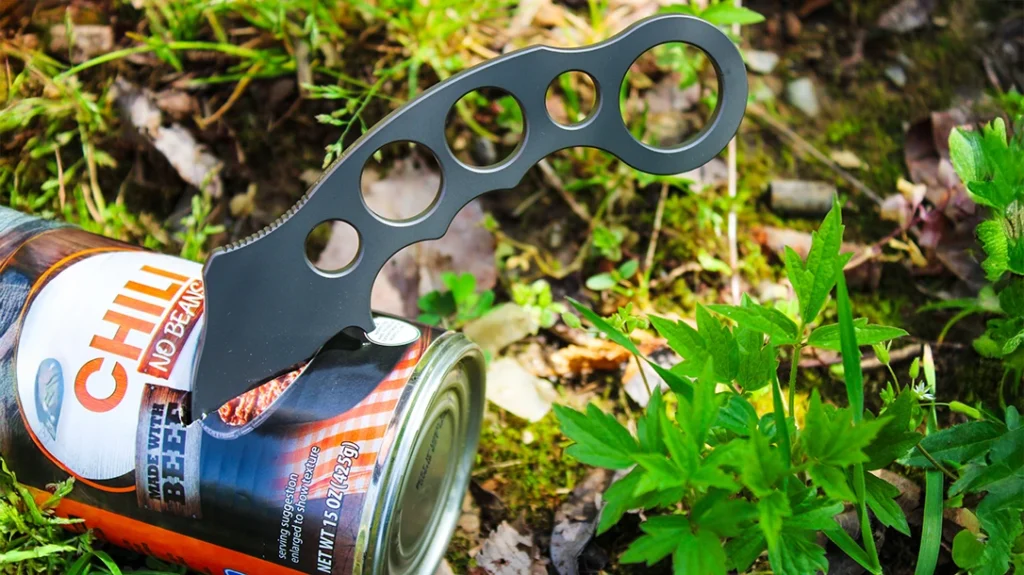
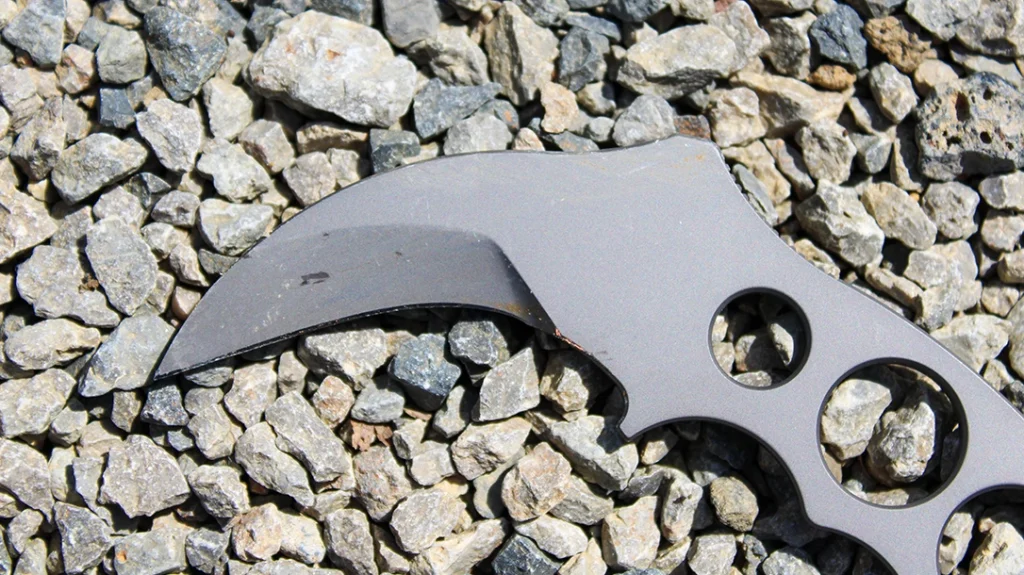
The final test was to throw it and drag it through gravel. I did this about a dozen times to see how the blade and edge held up. Aside from a few scuff marks, the blade maintained its edge, a testament to the quality of D2 steel. The marks just give the blade a bit of character.
Carrying the AR15 Karambit
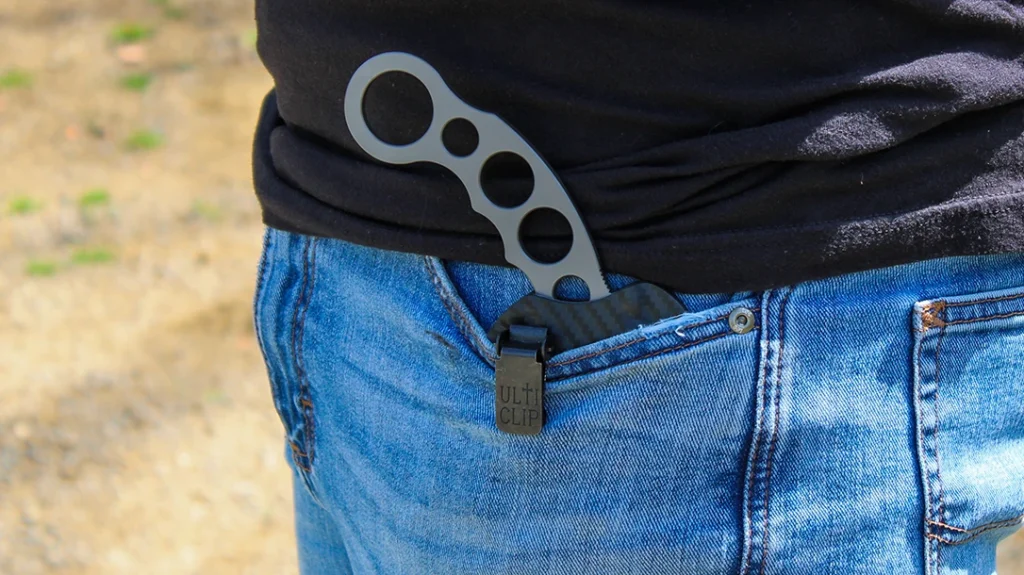
I didn’t carry the blade as intended. For fixed blades, I really like to pocket carry them, or at the very least, carry them on my waistband. While High Desert Blade Works ships an UltiClip with the knife, this one is really meant for use on a belt or a chest rig. I ordered the UltiClip Slim 3.3 from Amazon, which is the same one I’ve used on other fixed blades.
I experimented with different mounting positions and angles to find the best combination. Because of the blade’s shape, it naturally sits at a unique angle that may not suit everyone. It’s worth trying a few configurations to dial in what’s comfortable for you.
The Tarani AR15: A Cool Design with a Unique History
Throughout my time with the High Desert Blade Works Tarani AR15 Karambit, I’ve been highly impressed with its quality, durability, and overall design. As I’ve learned more about the knife and its intended use, I’ve come away even more impressed. It’s a cool design with a unique history. The fact that it was designed by Steve Tarani and Duane Dwyer only elevates the blade’s pedigree.
The Tarani AR15 Karambit retails for $145.00. Value-wise, I think it’s on par, and with what you get with the knife, it feels like a good value.
High Desert Blade Works Tarani AR15 Karambit Specs
| Blade Material | D2 |
| Rockwell Hardness | 60-61 |
| Blade Finish | Black or Grey PVD |
| Blade Thickness | 4.4 MM |
| Blade Length | 53 MM/2.08 Inches |
| Overall Length | 164.3 MM/6.4 Inches |
| Knife Weight Without Sheath | 3.9 Ounces |
| Sheath | Kydex Sheath Designed By Hawg Holsters |
| Extras | Neck Lanyard And Ulticlip Included |
| Designed By | Steve Tarani And Duane Dwyer |
| MSRP | $145.00 |
WHY OUR ARTICLES/REVIEWS DO NOT HAVE AFFILIATE LINKS
Affiliate links create a financial incentive for writers to promote certain products, which can lead to biased recommendations. This blurs the line between genuine advice and marketing, reducing trust in the content.