

My first gun was a .22 lever action (I was nine). My second rifle was a .30-30 lever action. I was a lever gun guy long before it was cool.
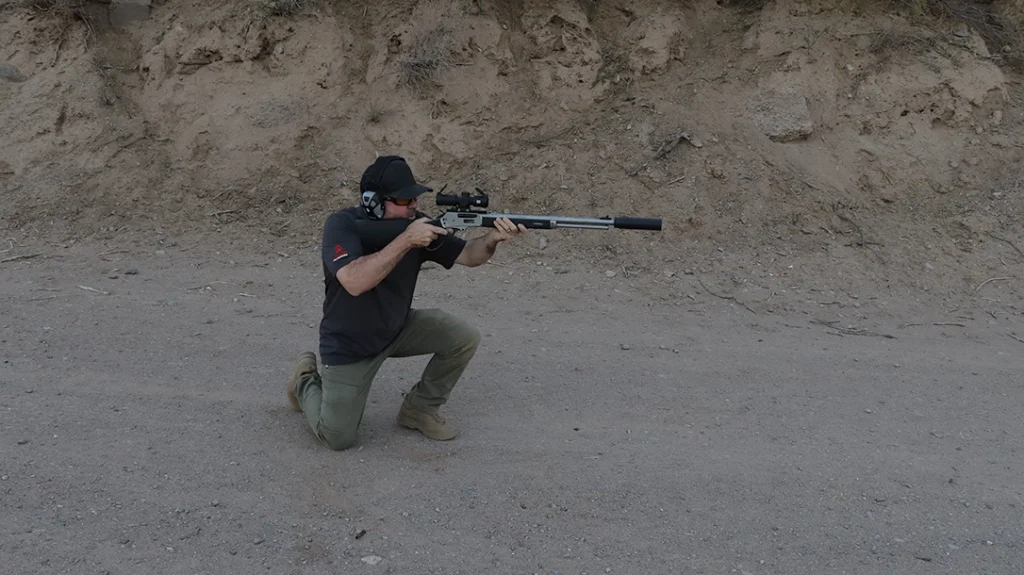
Recently, I was at the latest Athlon Outdoors Rendezvous and got to shoot the Smith & Wesson 1854 Stainless Steel in .30-30 with polymer furniture and the not yet released, Gemtech Neutrino suppressor. I prefer the look of wood stocks over polymer, but then I started shooting it. I hate to admit it: it’s better than the lever guns I grew up with in almost every way.
Naturally, the first thing I asked the S&W reps was, “What makes your lever gun better than all the ones that came before it?” They smiled and told me they recruited a small “confidential community” of experts to recommend possible improvements, then followed their advice. While not all of the advice was traditional, most of it was pretty good.
Advertisement — Continue Reading Below
S&W 1854 Stainless — Built to Improve
First, they made the gun 7.5 pounds to be lighter and more mobile. Nobody wants to pack a heavier gun around all day. It swings and points pretty smoothly, even with the suppressor mounted.
Next, they wanted to have the smoothest action on the market. If you can’t keep a lever gun in your shoulder while running the action, it isn’t smooth enough. On the other hand, I’ve seen lever guns where the lever literally fell open from its own weight which is not safe. I could keep the 1854 firmly in my shoulder and run it all day. Even the loading port was easier to use than any of my other lever guns.
Advertisement — Continue Reading Below
They also replaced the traditional straight grip stock with a pistol grip to offer better control for heavy recoil.
Better Sights & Modern Features
Next came the sights. Anyone who has replaced the factory iron sights on their lever gun with a Skinner Peep Sight knows it is probably the single greatest improvement you can make. It often nearly doubles the sight radius. The 1854 coming from the factory with a removable peep iron sight was a definite plus. The front sight is also removable with two screws.
The gun has several modern features. The gun has a factory mounted, extended Picatinny rail for an optic. I don’t want a Picatinny on my showpiece walnut stocked guns, but this is a working rifle. It was made to get dirty and take a beating and making it easy to mount a red dot or low power optic comes in handy.
Advertisement — Continue Reading Below
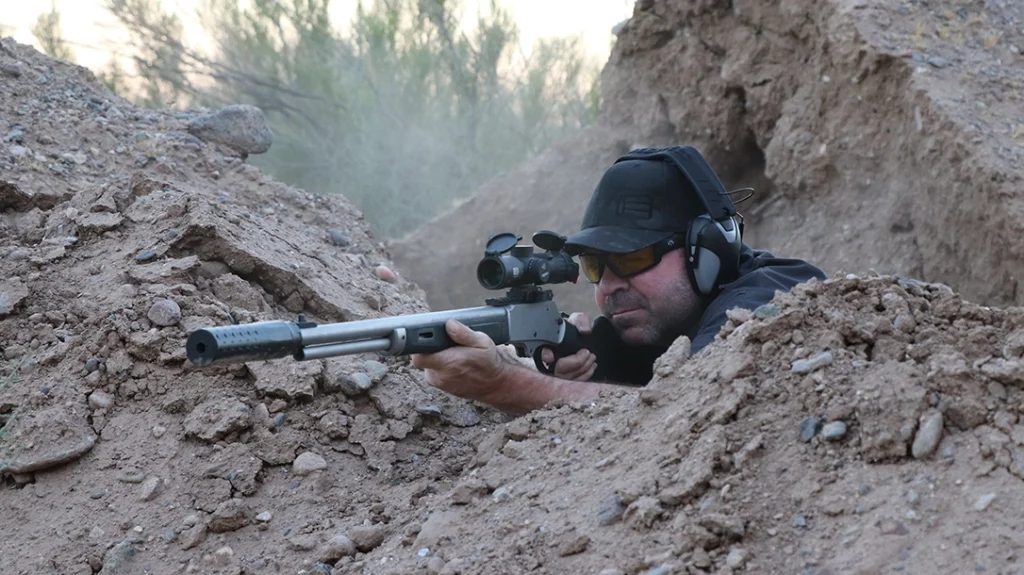
Second, it has three M-LOK mounting points if you want to quickly mount a bipod or a light.
Third, it has a flat-faced trigger which I use on all of my competition guns. I loved how it felt when I dry fired it, but when I was testing the gun, I found my finger kept hitting different points on the trigger which made for a slightly different trigger press. I am still on the fence whether I prefer the flat or curved trigger on this rifle.
Advertisement — Continue Reading Below
Gemtech Neutrino Suppressor
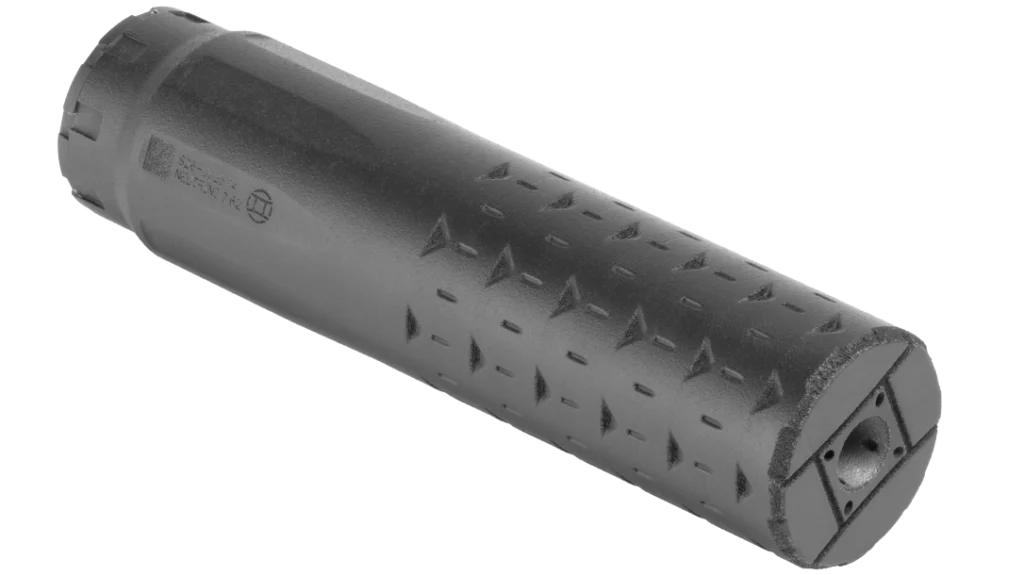
Last, the brand new Gemtech Neutrino was designed with a 3-D printed titanium core. When I first received it, I thought they sent me a plastic mockup by mistake. It weighs a ridiculous 8.8 oz.
I screwed it on the gun and never took it off again.
Advertisement — Continue Reading Below
Back when suppressors were rare and took a year to get ATF approval, I was all about being able to switch my can from one gun to the next. Nowadays, I want to put it on a gun and leave it there forever.
The Neutrino made the whole gun swing and point only slightly slower. The two are made for each other.
EOTech’s Compact Vudu Scope
Before I hit the range, the last thing I wanted was a top-of-the-line, low power variable optic, but I wanted something light, small and maneuverable to match this package.
Advertisement — Continue Reading Below
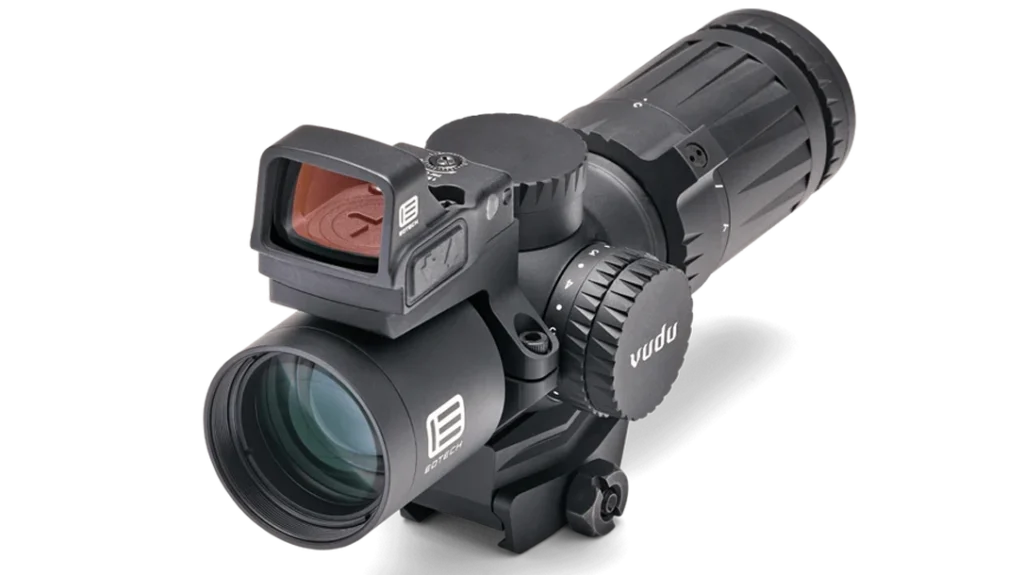
I reached out to EOTECH and they recommended their super short Vudu 3-9×32 SFP (Second Focal Plane) with illuminated MD6 reticle with MOA hash marks every 2.5 MOA.
It is a super compact 6.8 inches long, weighs one pound, and is built like a tank for hard use and abuse.
It is compatible with the Mini-ACOG mount, so I picked up an ADM Mini ACOG QD low mount which worked perfectly and got it down as low as possible to my bore axis.
I didn’t take the time to remove the rear peep sight which would have allowed it to sit a little farther back for better eye relief. Instead, for expediency, I repositioned my head a little farther forward and eye relief was fine, but long term, I would mount it slightly farther back.
I used 9 power for the accuracy test, but honestly, if hunting, I would probably just leave it on 3 power which gave me just enough magnification to get fast target acquisition, but still hone in on the vitals.
The reticle focus ring and 10 brightness settings allowed me to customize the sight to my preferences as I was testing and the light began fading at the end of the day.
I certainly liked having a second focal plane for hunting and the MD6 reticle’s hash marks helps in figuring hold overs with a caliber that tends to drop significantly after 300 yards.
Range Performance
There isn’t a lot to talk about with my range test since everything went without a hiccup. The gun, suppressor and scope all performed perfectly.
The one thing that surprised me was my ammunition.
I reached out to major ammunition manufacturers and asked them to send me their latest, greatest hunting ammo for .30-30. No surprise, Hornady sent some of their excellent LEVERevolution line, Federal sent Fusion Bonded Soft Point, and Remington sent Core-Lokt tipped Lever Gun rounds.
All of these worked well and would be ideal for taking deer or pigs.
What shocked me was both Federal and Hornady also sent me subsonic .30-30 Win rounds.
Have I been living under a rock?
I didn’t know anyone made subsonic .30-30.
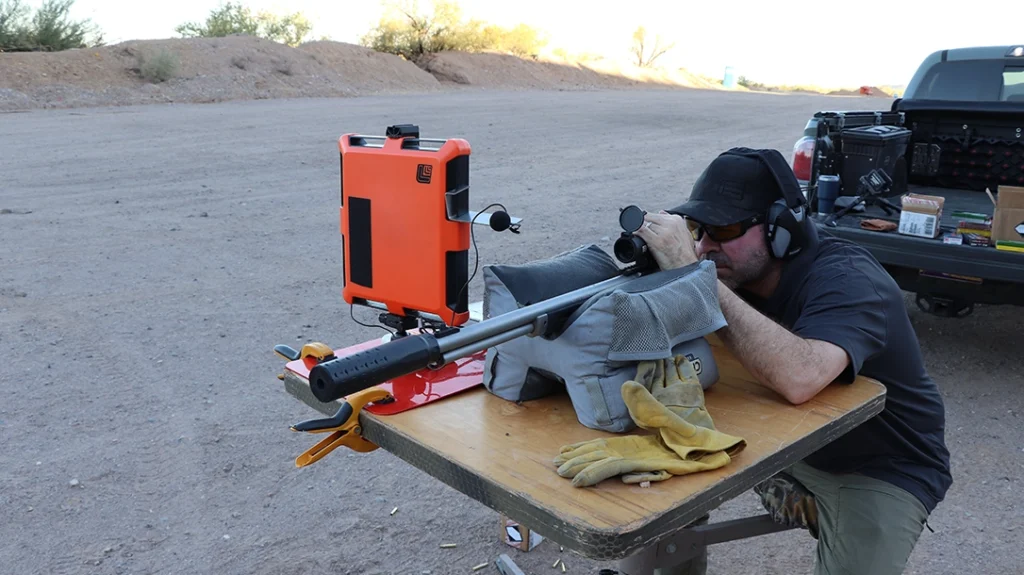
I tested everything at 100 yards. The point of impact of the subsonic ammo dropped about 12 inches from the hypersonic ammunition, but still patterned relatively well. I kind of thought it would be a 50-yard maximum range, but that was not the case.
Shoting without any ear pro and I was right next to a large wall, but it was still incredibly quiet. I could hear the report, then hear the bullet hit the cardboard a split second later.
Very cool.
I wished I had brought ballistic gelatin to see how it performed, but that would be a whole different article.
What I’d Still Change
No gun is perfect, and I wish I had been part of the “confidential community” that helped design the 1854 because I would have made a few suggestions.
First, half-cock is a great safety and the cross-bolt safety is redundant; they should ditch it.
What? The lawyers called and they will never allow a modern gun manufacturer to make a gun “less safe?” Oh well, something tells me someone else suggested that improvement too, but it’s never going to happen.
Secondly, the drop at comb of the stock is set up for using the iron sights, which is great, but I put a LPVO on mine. I would love to have a stock with an adjustable cheek rise on it to help with proper cheek weld.
Next comes the loop.
Ever since John Wayne had giant loops put on guns so his big mitts would fit and he could do crazy one-handed flip reloads, people think they need an oversize loop.
They actually slow down your reload.
Your hand has to travel farther before you begin physically cocking the gun.
Forget aesthetics, I would make the loop at least one-third smaller to make it faster to run. You could still fit a gloved hand in there just fine.
Besides that, I wouldn’t change a thing.
Smith & Wesson 1854 Stainless Specifications
- Caliber: .30-30 Win
- Barrel Length: 20 in.
- Overall Length: 37.8 in.
- Weight (Unloaded): 7.5 lb.
- Twist Rate: 1:10; 6-groove rifling
- Barrel Material: 410 Stainless Steel
- Sights: Rear Peep and Front Gold Bead (Top Picatinny)
- Muzzle: Threaded 5/8×24
- Handguard: Black Polymer
- Trigger Weight: 5 lb. 5 oz.
- Capacity: 5+1
- Buttstock: Black Polymer Pistol Grip
- Action: Lever Action
- MSRP: $1,399
Gemtech Neutrino Suppressor Specifications
- Caliber: 7.62
- Core: 3-D Printed Titanium
- Length: 6.53 in.
- Diameter: 1.625 in.
- Body Thread Pitch: 1-3/8×24
- Barrel Thread Pitch: 5/8×24
- Weight: 8.8 oz.
- MSRP: $899
Performance:
| Load | Velocity Avg. | Accuracy Avg. | Best Group |
|---|---|---|---|
| Federal 170 gr Fusion Bonded Soft Point | 2221 fps | 1.90 in. | 1.17 in. |
| Hornady 160 gr LEVERevolution FTX | 2352 fps | 3.13 in. | 2.74 in. |
| Remington 150 gr Core-Lokt Lever Gun | 2242 fps | 1.95 in. | 1.77 in. |
| Federal Subsonic 170 gr Target Soft Point | 1112 fps | 2.40 in. | 2.23 in. |
| Hornady 175 gr Subsonic SUB-X | 1096 fps | 2.51 in. | 2.37 in. |
Bullet weight measured in grains, velocity measured in feet per second 15 feet from the muzzle using Doppler radar, and accuracy measured in inches for three, five-shot groups at 100 yards.
WHY OUR ARTICLES/REVIEWS DO NOT HAVE AFFILIATE LINKS
Affiliate links create a financial incentive for writers to promote certain products, which can lead to biased recommendations. This blurs the line between genuine advice and marketing, reducing trust in the content.

