

Since Samuel Colt’s revolving handgun transformed firearms in the 1830s, the revolver has earned an enduring place in military service, law enforcement, hunting, competitive shooting, and personal defense. While Old West icons like Wyatt Earp and Wild Bill Hickok helped build the revolver’s legendary reputation, the shooters who followed them continued to shape its evolution in equally significant ways.
The following five individuals didn’t simply master the revolver. They influenced how it was designed, how it was used, and even how future generations learned to shoot.
Ed McGivern
Born in Omaha, Nebraska, in 1874, Ed McGivern hardly looked like the larger-than-life shooter he would become. Standing just 5-foot-5 with a stocky build, he earned the nickname “Stumpy” while working as a sign painter in Montana. Behind that ordinary appearance, however, was one of the greatest handgun talents the shooting world has ever seen.
Advertisement — Continue Reading Below
As a young man, McGivern became fascinated with firearms and devoted countless hours to developing extraordinary speed without sacrificing accuracy. Through relentless experimentation, he discovered that he could fire a double-action revolver faster than many shooters could operate a semi-automatic pistol. That discovery became the foundation of an exhibition shooting career that eventually replaced his work as a sign painter.
His demonstrations were nothing short of astonishing. McGivern routinely shattered airborne targets, struck multiple targets while firing two revolvers at once, and constantly pushed the limits of what seemed physically possible with a wheelgun. As his routines became more elaborate, speed became an obsession.
Advertisement — Continue Reading Below
His most famous accomplishment came on September 13, 1932. According to The Guinness Book of World Records, McGivern fired two separate five-shot groups from just 15 feet away, with each group small enough to be covered by a 50-cent piece. He completed the feat in only 0.45 seconds.
That record was only one example of his remarkable skill. He could hit a dime tossed into the air, drive nails into wood with bullets, split the edge of a playing card, remove the pips from playing cards with precision, and hit six hand-thrown skeet targets before they reached the ground. He even managed to strike a tin can thrown 20 feet into the air six separate times before it landed. Adding to the challenge, McGivern was ambidextrous and performed all of these feats shooting double-action revolvers.
McGivern’s influence extended well beyond exhibition shooting. He wrote extensively on handgun techniques, trained countless law enforcement officers, helped develop improved revolver sights, collaborated with famed gun writer Elmer Keith on revolver cartridges, and advanced the practice of long-range handgun shooting.
Advertisement — Continue Reading Below
Jack Weaver
By the late 1950s, competitive defensive handgun shooting was still in its infancy. The South West Combat Pistol League hosted what became known as “Leather Slap” matches near California’s Big Bear Lake. Instead of traditional bullseye shooting, competitors were challenged with realistic defensive scenarios requiring fast draws and accurate hits at close range.
Colonel Jeff Cooper, who helped pioneer these competitions, believed they provided the most realistic test of practical handgun skills. Most competitors approached the matches the same way. They carried low-slung Hollywood-style cowboy holsters and fired one-handed from waist level using instinctive point-shooting techniques.
Then Jack Weaver showed up.
Advertisement — Continue Reading Below
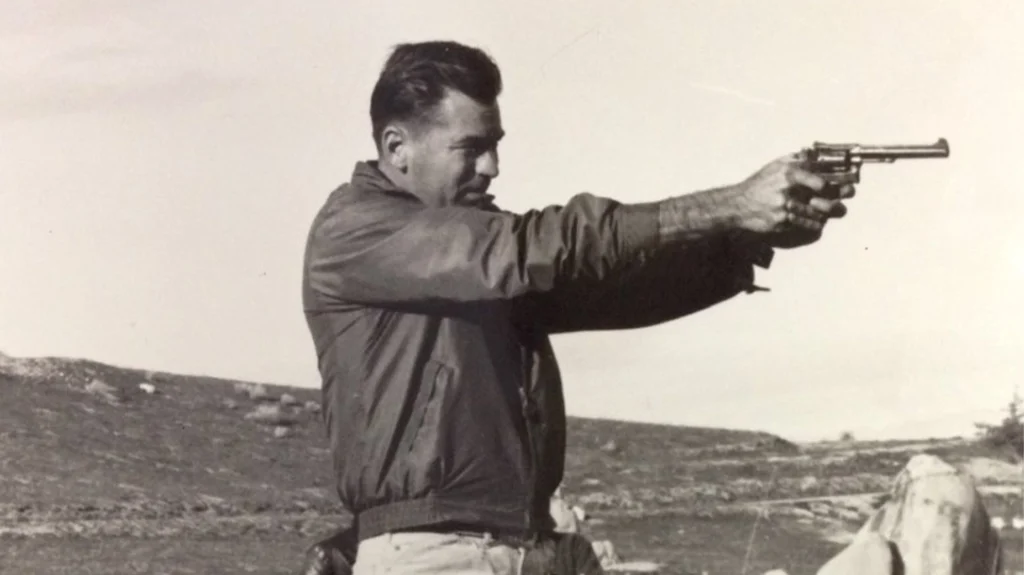
Born in California in 1928, Weaver had been fascinated by revolvers since childhood. Following military service, Weaver joined the Los Angeles County Sheriff’s Department, where he also became a member of the department’s pistol team. During the 1959 Leather Slap competition, Weaver departed from conventional wisdom by gripping his revolver with both hands. His unconventional technique dramatically improved both recoil control and accuracy, helping him win the championship.
Jeff Cooper quickly recognized the effectiveness of Weaver’s technique and named it the “Weaver Stance.”
Advertisement — Continue Reading Below
The system combined an extended firing arm with a bent support arm, creating opposing push-and-pull tension that stabilized the revolver. The shooter drew the handgun with the strong hand, met it at centerline with the support hand, extended the pistol to eye level, acquired the sights, and fired.
The improvement over traditional point shooting was undeniable.
The stance delivered greater accuracy, faster follow-up shots, improved recoil management, and quicker target transitions. It wasn’t long before nearly every Leather Slap champion adopted it.
Advertisement — Continue Reading Below
Eventually, the Weaver Stance became a cornerstone of Cooper’s “Modern Technique” of handgun shooting. The FBI formally adopted it in 1982, and it soon became the standard defensive shooting position taught throughout American law enforcement.
Weaver remained with the Los Angeles Sheriff’s Department until retiring in 1979. He passed away in 2009, but every two-handed shooter today owes part of their technique to his willingness to challenge conventional thinking.
Elmer Keith
Born in 1899, Keith lived the kind of life that made him uniquely qualified to influence the firearms industry. He was a rancher, hunter, big-game guide, author, ballistician, reloader, and firearms expert. Early in his career, Keith began experimenting with increasingly powerful handloads for the .38 Special. Those experiments were made possible by the availability of heavy-frame Smith & Wesson revolvers like the .38-44 Heavy Duty and Outdoorsman. His work demonstrated that handgun cartridges could safely achieve far greater performance than many believed possible.
Those experiments directly contributed to Smith & Wesson introducing the .357 Magnum in 1935.
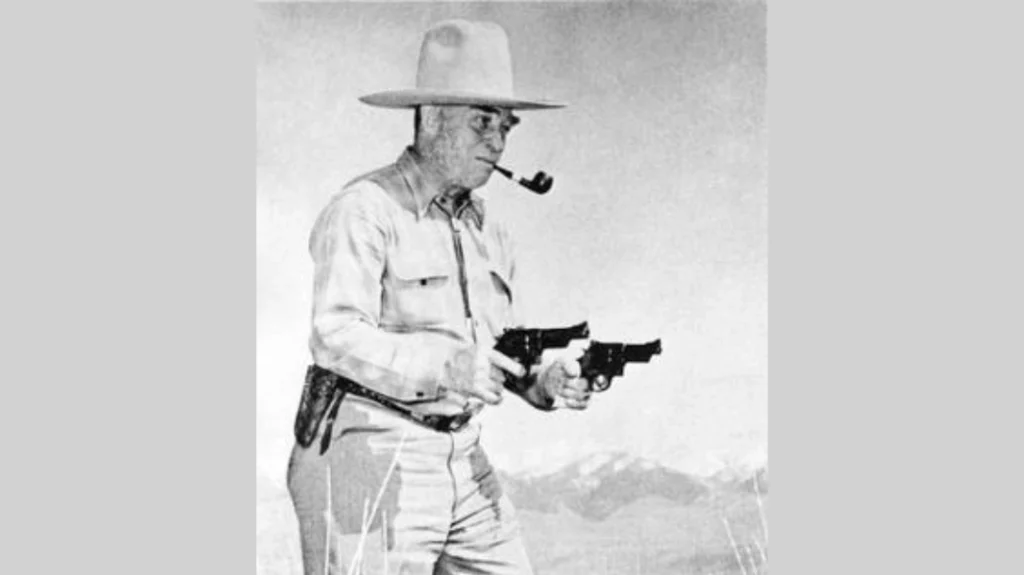
Keith’s influence didn’t stop there. He also designed what became known as the Keith-style bullet, a projectile that offered deeper penetration and improved terminal performance. It quickly became one of the most respected cast bullet designs ever created.
He encouraged Remington to develop a more powerful .44-caliber cartridge and urged Smith & Wesson to build a revolver strong enough to chamber it. Their collaboration culminated on January 19, 1956, with the public introduction of the .44 Remington Magnum and the Smith & Wesson Model 29.
The .44 Magnum became the first handgun cartridge widely recognized as suitable for taking every species of North American big game. It also sparked an explosion in the popularity of handgun hunting that continues today.
Bill Jordan
For much of the 20th century, American law enforcement relied almost exclusively on revolvers. The .38 Special served faithfully for decades, but by the 1960s, officers increasingly found themselves facing heavily armed criminals. Many believed they needed more stopping power than the traditional service revolver could provide.
One Border Patrol officer helped deliver that solution.
Born in Louisiana in 1911, Bill Jordan spent most of his career patrolling the Mexican border during some of the agency’s most dangerous years. When World War II began, he left to serve in the U.S. Marine Corps before returning to the Border Patrol after the war. Following his retirement in 1965, Jordan became a respected firearms instructor, exhibition shooter, NRA field representative, and bestselling author.
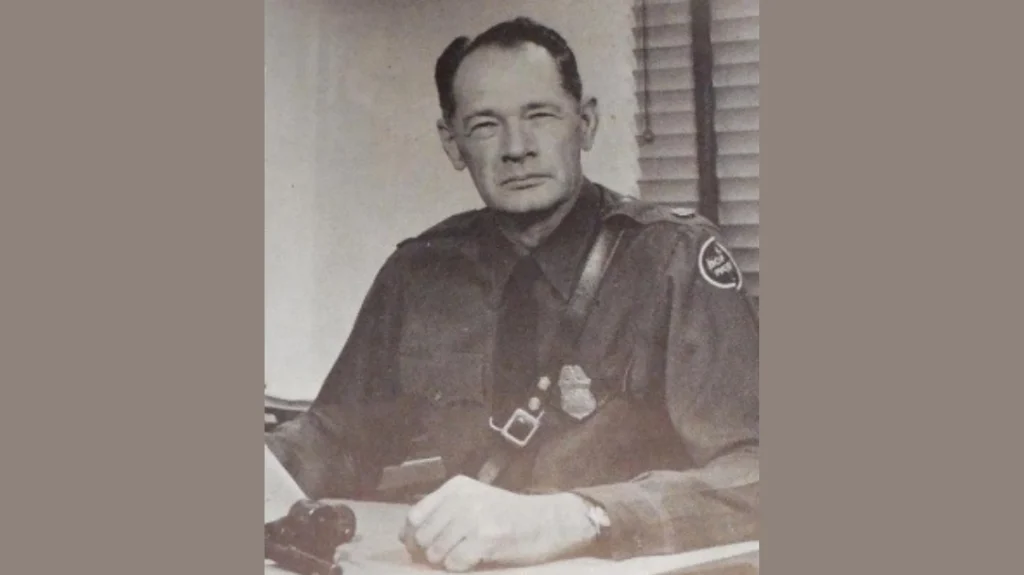
One of his signature performances involved balancing a ping pong ball on the back of his shooting hand while holding it roughly six inches above his holstered revolver. As he began his draw, the ball dropped. By the time he had drawn and fired, the revolver occupied his hand and the ping pong ball had fallen neatly into the now-empty holster after traveling less than a foot.
Jordan believed deeply in the double-action revolver as a fighting handgun, but he also believed the .38 Special no longer offered adequate stopping power for police work.
At the 1954 National Matches at Camp Perry, Smith & Wesson president Carl Hellstrom asked Jordan what he considered the ideal law enforcement revolver.
Jordan envisioned a .357 Magnum chambered in the company’s medium-sized K-Frame, equipped with a heavy barrel, adjustable sights, target stocks, and a shrouded ejector rod. The result would provide Magnum performance without the bulk and weight of the larger N-Frame revolvers then available. Smith & Wesson listened.
The following year, the company introduced the .357 Magnum K-Frame Combat Magnum, later designated the Model 19. A stainless-steel version, the Model 66, followed later.
The revolver proved to be exactly what Jordan envisioned. A sidearm powerful enough for law enforcement while remaining comfortable enough to carry throughout a long shift.
For years, the Model 19 and Model 66 became the standard by which police revolvers were judged. Agencies across the country adopted them before gradually transitioning to semi-automatic pistols during the late 1980s and 1990s.
Jerry Miculek
Spend enough time around competitive shooters, and one name is guaranteed to come up whenever revolvers are discussed: Jerry Miculek.
Known throughout the shooting world as “Mr. Revolver,” Miculek has demonstrated that the wheelgun remains every bit as capable as modern semi-automatic pistols when placed in skilled hands.
After entering action shooting competitions during the 1980s, Miculek’s extraordinary revolver skills quickly set him apart. By 1989, he had become a full-time professional shooter. Since then, he has built one of the most decorated competitive shooting careers in history.
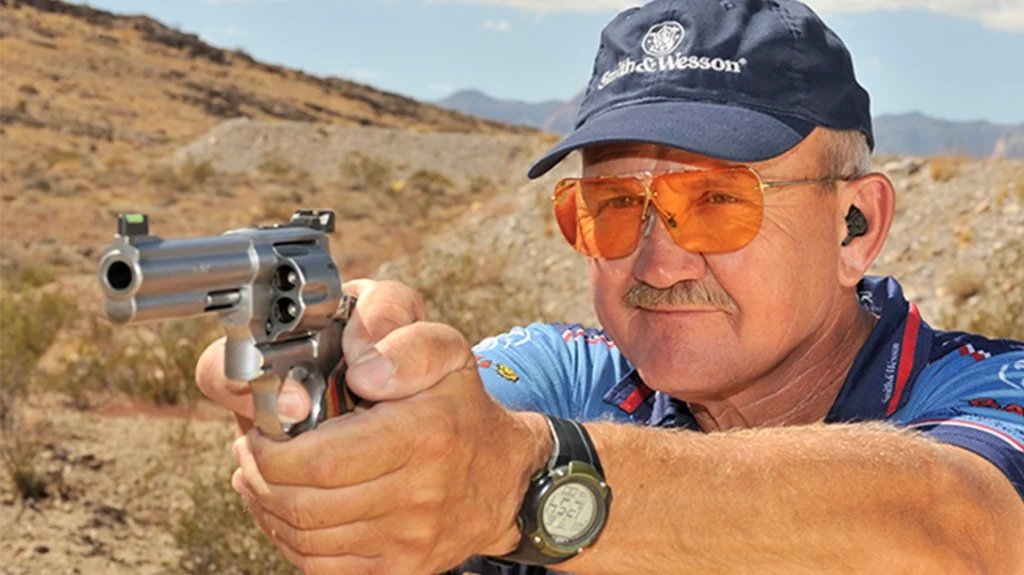
His accomplishments include championships in nearly every major revolver discipline: four Second Chance Bowling Pin titles, USPSA National Revolver Champion, IDPA National Revolver Champion, IDPA World Revolver Champion, Steel Challenge Revolver Champion, International Revolver Champion, IPSC Revolver World Champion, and Senior IPSC Revolver World Champion.
His world records are equally remarkable. Among them are firing eight shots in one second; shooting 60 rounds from 10 revolvers in just 17.2 seconds; firing two shots on each of three targets in one second; completing six shots, a reload, and six more shots in only 2.99 seconds; and firing five shots in 0.57 seconds.
Competitive shooting is also a family tradition. His wife, Kay, and daughter, Lena, are both accomplished professional shooters and teammates on Team Smith & Wesson.
Despite his extraordinary achievements, Miculek has earned just as much admiration for his humility, generosity, and approachable personality as for his shooting ability.
A Lasting Legacy
These five shooters came from remarkably different backgrounds; an exhibition shooter, a deputy sheriff, a rancher, a Border Patrol officer, and a world champion competitor. Yet each left an unmistakable mark on revolver history.
Whether through groundbreaking shooting techniques, cartridge development, equipment design, or record-setting performances, they expanded the limits of what a revolver could accomplish.
WHY OUR ARTICLES/REVIEWS DO NOT HAVE AFFILIATE LINKS
Affiliate links create a financial incentive for writers to promote certain products, which can lead to biased recommendations. This blurs the line between genuine advice and marketing, reducing trust in the content.

