

Exploring the History, Innovation and Lasting Influence of an American Icon
The Colt Model 1911: The Pistol That Defined a Century didn’t earn its legendary status overnight. Before its adoption by the U.S. military in 1911, inventors around the world were racing to perfect the self-loading pistol. Their innovations paved the way for one of the most successful handgun designs ever created. Even before the turn of the last century, gunmakers were working in earnest to design a practical self-loading pistol.
The Race to Build the First Reliable Semi-Automatic
The first real breakthrough was by an Austrian designer named Joseph Laumann. His patent was assigned to the Österreichische Waffenfabrik Gesellschaft at Steyr in Austria. The 1892 Schönberger-Laumann pistol was one of the first autoloaders ever produced. In 1893, German arms designer Hugo Borchardt and his colleague Georg Luger developed the Borchardt Automatic Repeating Pistol. This gun incorporated Georg Luger’s toggle-lock action, which would become the foundation for Luger’s remarkably successful 9mm, introduced in 1900.
Another soon-to-be-famous German arms-maker, Peter Paul Mauser, had introduced an entirely different approach. A bolt mechanism inside the slide to extract and eject the spent cartridge casing, cock the hammer, and strip a fresh cartridge from the magazine as the slide rebounded and closed. If that sounds familiar, it is the way almost every semi-auto pistol in the world works, only the Mauser’s barrel and slide were one piece. The Mauser C96, better known today as the “Broomhandle,” became one of the most successful handguns in history.
Advertisement — Continue Reading Below
John Browning’s Road to the Model 1911
John Moses Browning’s earliest patent for a semi-auto is dated April 20, 1897. A date that would appear on the slides of Colt semi-automatic pistols for nearly half a century. Between 1900 and 1911, Browning’s designs would make Colt one of the world’s leading producers of self-loading pistols. The road leading to the development of the Model 1911 was well traveled. Browning with an entire series of semi-auto designs for Colt beginning in 1900.
Browning and his family were responsible for one of the earliest small-caliber autoloaders to find favor with lawmen at the turn of the century. The Belgian-manufactured FN Model 1900 chambered in 7.65mm (.32 ACP). Around the same time, Browning licensed his 1897 patent design to Colt for Colt’s Model 1900. This was chambered in the new .38 rimless smokeless cartridge, originally called the “Colt Automatic Pistol Hammerless,” or CAPH. Later, this was shortened to ACP. This cartridge was more related to the .38 Long Colt. Browning’s Model 1900 formed the basis for an entire series of semi-automatic pistols that would lead to the Model 1911.
Advertisement — Continue Reading Below
The Military Takes Interest
One of the great incentives for further development in the early 1900s was the U.S. military’s interest in seven-shot semi-autos. The Army and Navy procured Colt Model 1900 pistols for evaluation—around 50 for the Navy and 200 for the Army. The improved Colt Model 1902 (sporting) automatic pistol found even more favor with the government. Changes in the design included a rounded hammer, a shorter firing pin, a dovetail-mounted rear sight, and checkered, hard-rubber grips.
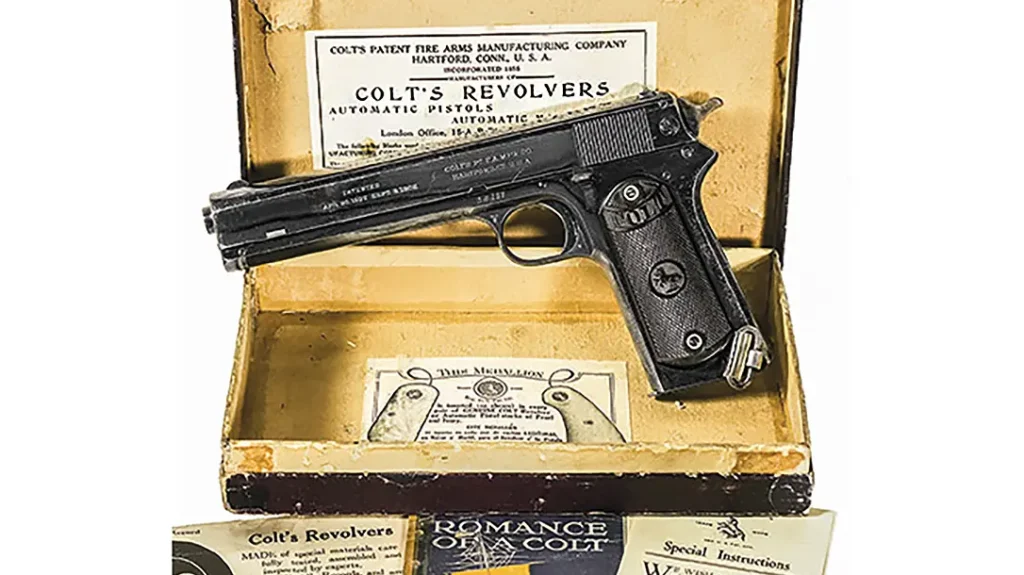
To meet Ordnance Department requirements, the military versions had a longer, squared grip at the butt, a lanyard swivel on the lower-left side of the grip frame, a slide stop on the left side of the frame, and an eight-shot magazine. The civilian versions carried one less round. The military’s Model 1902 remained in the Colt catalog until 1928, with production reaching over 47,000 examples
Advertisement — Continue Reading Below
In between production of the Model 1902, the Model 1903 and development of the first Hammerless semi-automatic Colt pistols came a design that is regarded as the quintessential stepping stone to the 1911, the Model 1905. This new .45 ACP handgun was cataloged as the “Model 1905 .45 Automatic Pistol.” The similarities between the Model 1905 and the later Model 1911 are unmistakable, as are the differences. Colt’s first .45-caliber semi-auto used a rimless smokeless cartridge designed by Browning. The new gun and cartridge were exactly what the U.S. military had been waiting for.
Complications Arise
Unfortunately, the Model 1905 left a lot to be desired as a military sidearm. To the average serviceman, it was complicated compared to a revolver, and the .45 ACP recoil was substantial. Nevertheless, in 1907 the U.S. government placed an order for 200 of the new semi-auto Colts for evaluation. Military versions required Colt to develop a grip safety engineered by Colt factory designers Carl Ehbets and George Tansley. They patented the design. Browning had also patented a similar grip safety device. This was first seen on the FN Model 1905 and three years later on Colt’s Model 1908 Pocket Hammerless models
The .45-caliber 1907 contract models differed from civilian models built that same year. They were designed to accept a detachable shoulder stock, which Colt later offered as a shoulder stock/holster for the civilian market. They also used a spur-type hammer instead of the civilian-style rounded hammer. Four different hammer designs appeared throughout the pistol’s production history.
Advertisement — Continue Reading Below
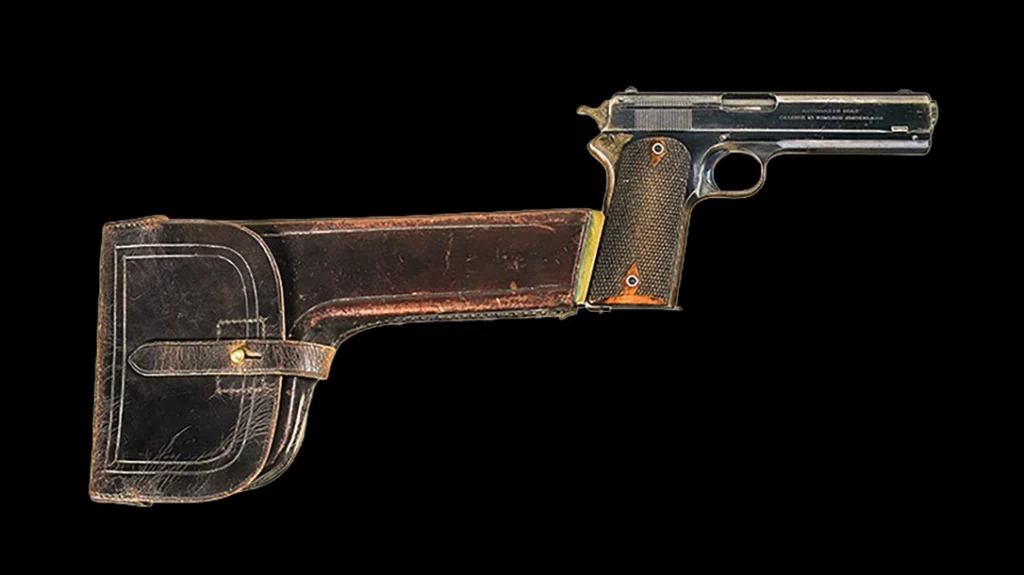
The military models also featured a lanyard loop so soldiers could tether the handgun to a braided shoulder lanyard. In addition, the government required changes to the ejector and a larger ejection port. All 200 pistols had their own serial number range and were equipped with a grip safety. Today, they are considered the rarest variation of the Model 1905. Despite these improvements, cavalry field tests still revealed numerous shortcomings for military service.
Meeting Military Requirements
Although the government’s 1907 tests were less than favorable, Colt and Browning reworked the design in 1909 and again in 1910 to meet military requirements. One of the most significant improvements was replacing the Model 1905’s double-link barrel locking system with the single toggle link used in the Model 1911.
Advertisement — Continue Reading Below
The Model 1905’s barrel was pinned to the frame by two pivoting barrel lugs. It remained attached at both the muzzle and breech, making the pistol inherently accurate but much more difficult to field-strip. The slide was secured by a wedge passing through it just below the muzzle. Over time, that wedge proved to be a design weakness and one of the Model 1905’s primary points of failure during military field tests.
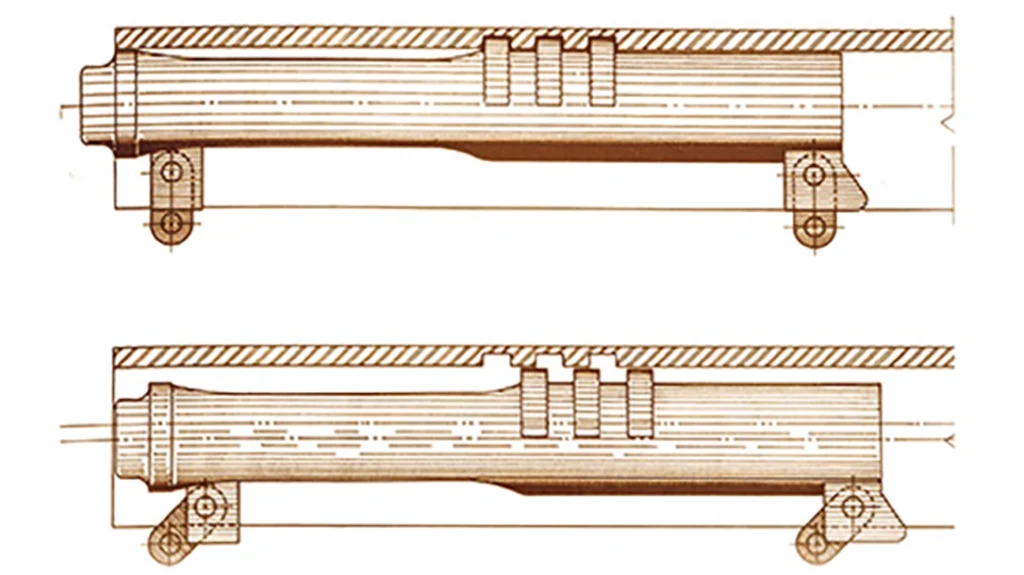
Upon firing, the Model 1905’s barrel pivoted backward and disengaged from matching grooves in the slide. This allowed the slide to unlock from the barrel and continue its rearward movement. Field-stripping the pistol was more complicated. Removing the barrel required punching out two small pins. Those pins occasionally fractured, creating another point of failure in military testing. Browning solved the problem by developing his single toggle link. It anchored the barrel while making disassembly much easier and the overall design significantly stronger. The improvement also established the tilting-barrel system, which has remained the global standard for semi-automatic pistols for well over a century.
Advertisement — Continue Reading Below
Final Modifications
For the 1910 military trials, Browning and Colt made additional changes to the 1905 grip design and angle, which Browning stated would further improve handling. After an initial field test in February of that year, Colt made a few more modifications, at which point the 1910 looked essentially like the 1911, except for a thumb-activated safety. A second series of tests was conducted in November, and the military’s Board of Officers rendered a more favorable opinion but presented yet another list of critiques that Colt would have to address. These would lead Browning and Colt to the final design for the Model 1911.
Military Trials That Changed Handgun History
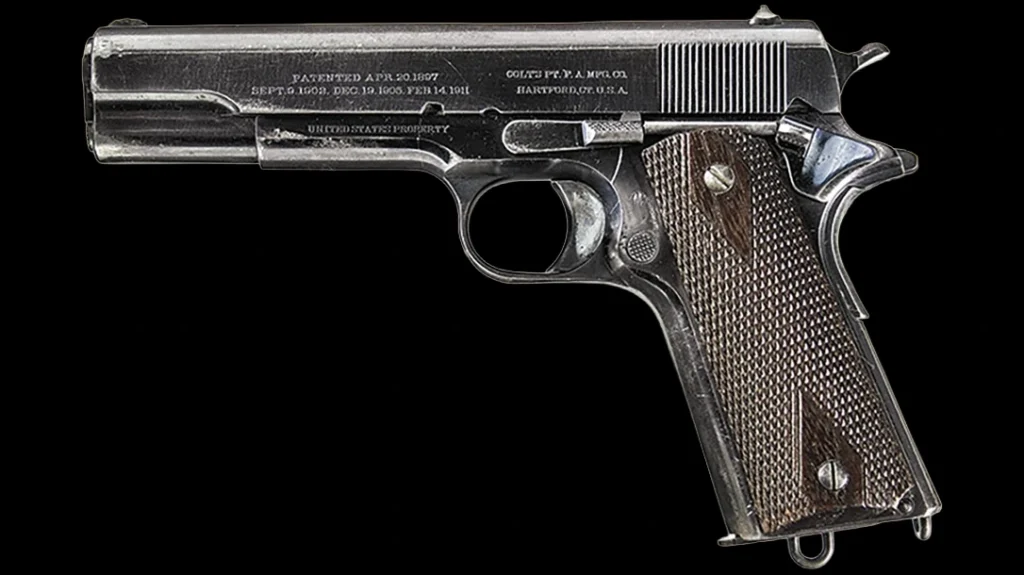
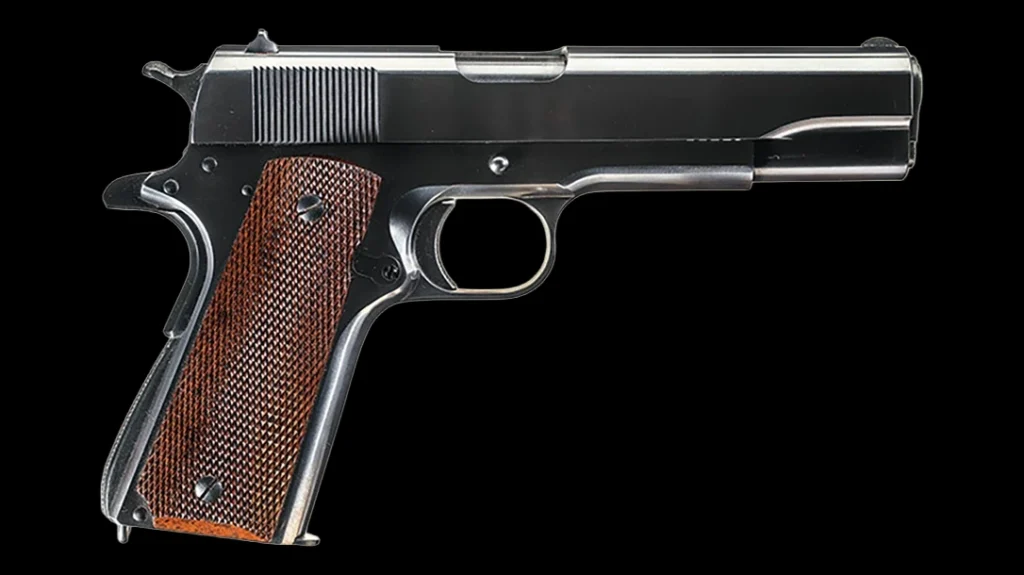
On March 3, 1911, the new Colt semi-auto design performed flawlessly, firing 6,000 rounds of ammunition, and addressing all of the Ordnance Department’s concerns, including the addition of an external safety so the gun could be carried with the hammer cocked (although military protocols stated that the guns were to be carried with an empty chamber). On March 29, 1911, U.S. Secretary of War Jacob M. Dickinson approved the selection of the Colt Browning as the “Automatic Pistol, Caliber .45, M1911.” The government’s initial order was for 31,344 pistols. Six years later, the 1911 would see service in World War I. By the end of World War II, more than 2,550,000 Model 1911/1911A1s had been produced for the U.S. government.
The Model 1911 was adopted as the official sidearm of the U.S. Army, Navy, Marine Corps and federal agencies, and remained in continual use until the improved Model 1911A1 was introduced in 1924. The 1911A1 was distinguished by a shorter trigger, a larger grip safety and, most notably, an arched, knurled mainspring housing that fit the palm swell of the shooter’s hand. The new model eventually replaced all of the original military 1911s and became the standard commercial version, although today’s modern 1911s often have the original flat mainspring housing, which has become the more desirable of the two designs.
Two World Wars
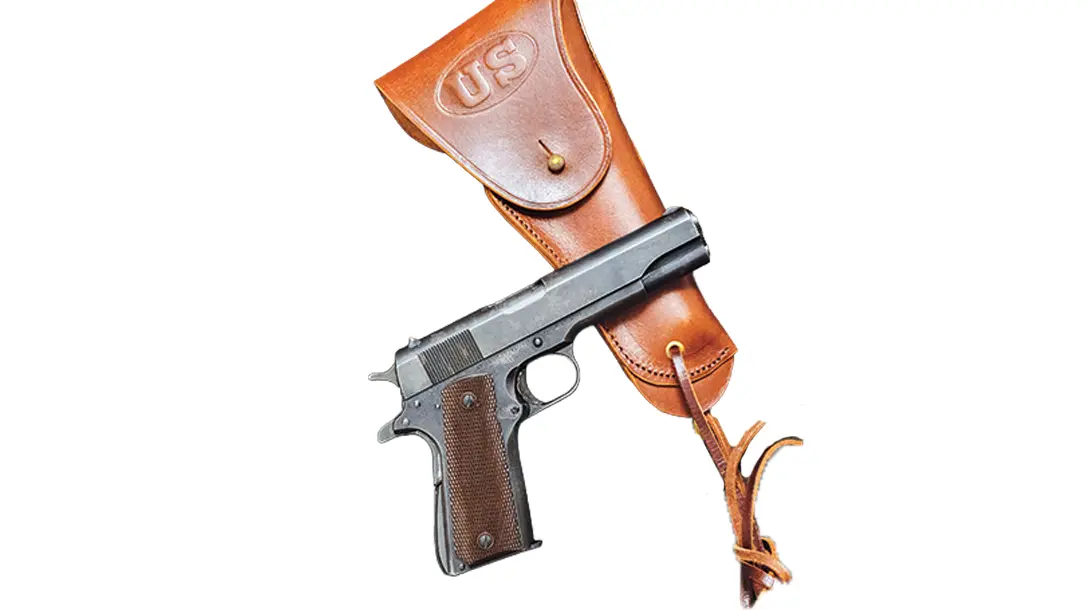
Two World Wars increased demand for the Model 1911 beyond Colt’s production capacity, requiring the company to license other manufacturers to produce guns to meet military quotas. The first request came in 1914 (three years before the U.S. entered WWI) with approximately 30,000 guns being produced at the Springfield Armory through 1915. From 1918 to 1919, Remington-UMC manufactured over 21,500 Model 1911s. North American Arms in Quebec, Canada, produced an additional 100 in 1918.
WWII demands again outstripped Colt’s capacity, and guns were made from 1943 to 1945 by Ithaca Gun Co. and Remington Rand, totaling over 1.3 million 1911A1s. In 1942, Singer (the sewing machine company) began manufacturing the 1911A1 (only about 500), and in 1943, Union Switch & Signal Co. produced as many as 400,000 1911A1 models for the war effort. These guns all bear their maker’s names and markings. Wartime Colts also bear special stampings, including “United States Property” and the specific branches of service.
Civilian Market Demands
The Model 1911 was intended to be a military sidearm but its popularity in the civilian marketplace was just as robust, leading Colt to develop the Model 1911A1 National Match pistol in 1933. This was a Colt Government Model designed for target shooting. The National Match was equipped with a “Super-smooth, hand-honed target action—selected ‘Match’ barrel—and two-way adjustable rear sight.” The original National Match pistols were manufactured up to the beginning of WWII, when military demand superseded the needs of the civilian market.
The Model 1911A1 also became available in .38 Super beginning in 1928. Colt then introduced the .22-caliber Ace in 1931 and the .38 Super Match (a .38 Super variant of the .45 ACP National Match) in 1934. Throughout Colt’s production, there were also special custom shop models, contract versions for foreign governments, factory-engraved guns, .22-caliber conversion kits, the introduction of the compact Commander in 1949 (fitted with a shorter slide and a 4.25-inch barrel), and the postwar reprise of the 1911 target model as the Gold Cup National Match, introduced in 1957. The Model 1911A1 was pretty much the gun in America by the late 1950s. In the second half of the 20th century, more police departments would make the switch from wheelguns to Colt 1911s.
A Legacy That Continues Today
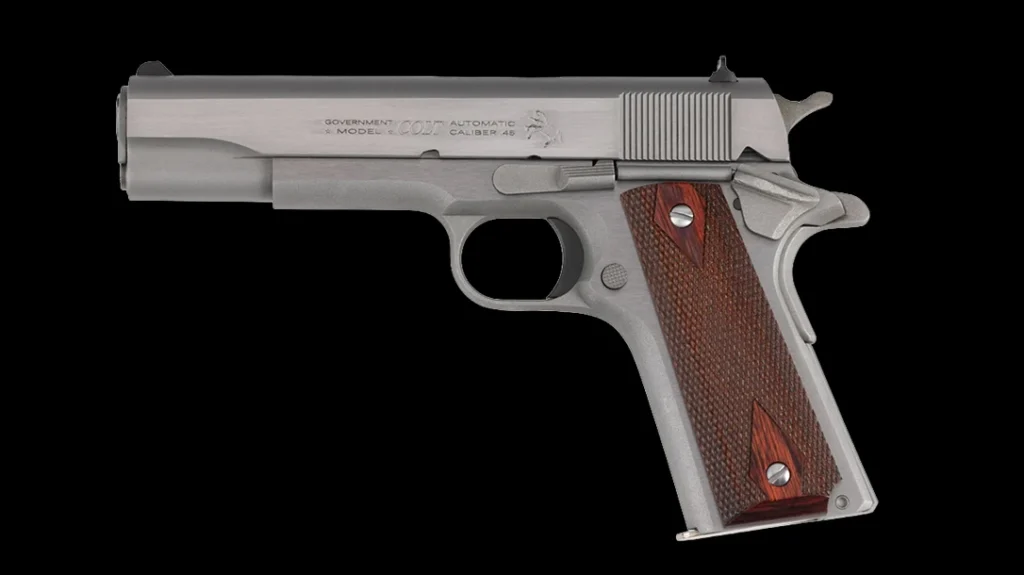
During the decades that followed, the 1911 platform expanded well beyond Colt. Manufacturers including Springfield Armory, Kimber, Smith & Wesson, Ruger, Dan Wesson, SIG Sauer, Wilson Combat, Ed Brown, Les Baer, Cabot Guns and others introduced their own interpretations of Browning’s design. Today, the 1911 is available in countless configurations, barrel lengths and calibers. More than 115 years after its adoption, it remains one of the most versatile and respected handgun platforms ever developed.
More than 115 years after its adoption by the U.S. military, The Colt Model 1911: The Pistol That Defined a Century continues to live up to its reputation. It remains one of the few handgun designs still produced by dozens of manufacturers worldwide. From military history and competitive shooting to concealed carry and collecting, the 1911 has earned a place few firearms will ever match. John Browning’s masterpiece continues to influence modern handgun design, proving that truly exceptional engineering never goes out of style.
Editor’s Note: Portions of this article are excerpted from the author’s book, Colt: 175 Years, published by Barnes & Noble.
WHY OUR ARTICLES/REVIEWS DO NOT HAVE AFFILIATE LINKS. Affiliate links create a financial incentive for writers to promote certain products, which can lead to biased recommendations. This blurs the line between genuine advice and marketing, reducing trust in the content.

