

Across much of the South, feral hogs are more than just a hunting opportunity. They are a serious problem. Descended from escaped domestic pigs and Eurasian wild boar, these invasive animals tear up crops, damage habitat, and cause millions of dollars in agricultural losses each year. In states like Texas, where feral hog populations have exploded, hunters can pursue them year-round with few restrictions.
While many hunters focus on population control, plenty also appreciate the quality table fare a wild hog can provide. The question becomes: what do you do once the animal is on the ground?
If you’re hunting near camp or have access to a skinning rack, block and tackle, or a sturdy tree limb, the traditional gut-and-skin method works well. But in many places, particularly in the open country of Texas and other southern states, those conveniences aren’t always available. That’s where this “no-gut” field butchering method comes in.
Advertisement — Continue Reading Below
The most important tool for field butchering a wild hog is a sharp drop-point knife. The flat spine of a drop-point blade rides against bone while the cutting edge separates hide from meat. By cutting from the inside out, you minimize the amount of dirt and hair that ends up on your meat.
Because hogs spend much of their lives rooting through mud, sand, and debris, field dressing can be tough on a knife’s edge. Keeping a sharpening tool nearby is a smart move.
Other useful tools include heavy duty platic bags, game bag, work gloves, and shears.
Advertisement — Continue Reading Below
Skinning the Hog
Start with the hog lying on its side. The process is completed on one side before rolling the animal over and repeating it on the opposite side.
Begin by making a cut along the spine from the base of the tail to the base of the skull. Next, follow the back of the hind leg until it meets the spinal cut. Continue around the leg, then up the front of the hind leg.
Advertisement — Continue Reading Below
From there, extend the cut forward along the edge of the rib cage and down the back side of the front leg. Circle around the front leg and continue toward the jowl area.
It’s important that the cuts made along the back and belly do not connect.
Once the hide is cut, grab it near the hindquarters and begin pulling it forward. The hide can be cut free as you go. If you have a hunting partner, one person can hold the leg while the other pulls the hide. If you’re alone, tie the leg to a solid object and use leverage to pull the hide free.
Advertisement — Continue Reading Below
As the hide peels away, the hair goes with it, exposing clean meat ready for processing.
Removing the Hindquarters
The hindquarters are often the best cuts on a hog and, unless the animal was poorly hit, should be largely undamaged.
Lift the hind leg up and over the animal’s back to create tension in the muscles. As tension appears, cut those muscles while continuing to pull the leg away from the body. All cuts should work inward toward the hip joint.
Advertisement — Continue Reading Below
A useful trick is to hook the hoof behind your knee, effectively creating a third hand that helps maintain tension while you cut.
There is no need to saw through bone. Continue cutting tissue across the face of the hip joint until the joint naturally opens. Once exposed, continue cutting around the front of the leg and the entire quarter will come free.
To remove the hoof, stretch the knee joint and locate the long white tendon running across the back. Roughly one-third of the way up the tendon is the joint itself. Cut through the tendon and the knee will separate cleanly.
Advertisement — Continue Reading Below
Keeping a heavy-duty plastic bag beneath the leg helps catch the quarter as it drops free.
Taking Off the Shoulders
The front shoulders come off even easier than the hindquarters. Lift the front leg toward the hog’s head and begin cutting inward toward the shoulder blade. Continue separating muscle and connective tissue while maintaining tension.
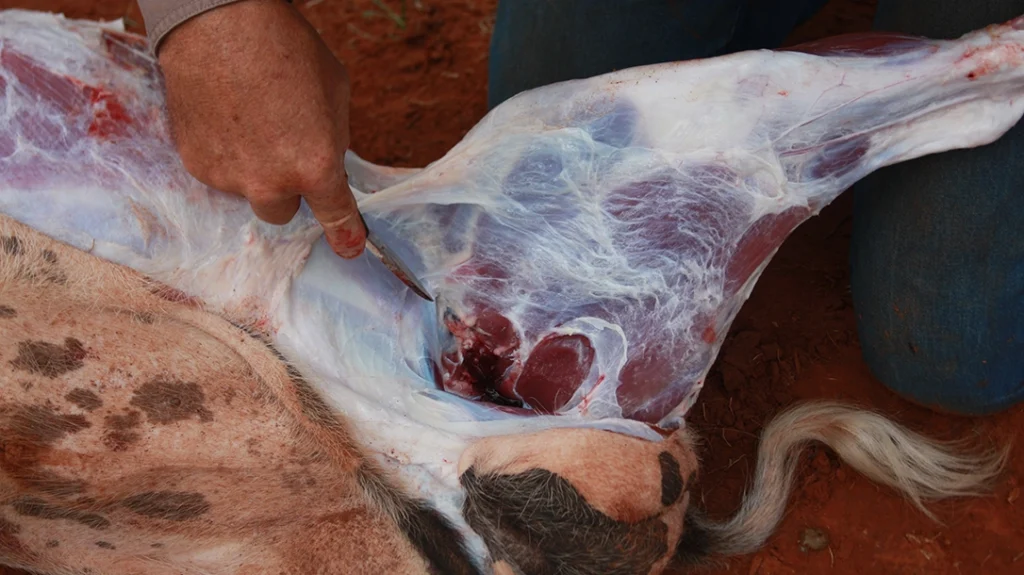
Unlike the hindquarter, there is no true joint attaching the shoulder to the body. Once the tissue is severed, the shoulder comes free naturally. Remove the hoof using the same method used on the rear leg.
Harvesting the Loin
The loin, often called the backstrap by hunters, runs along each side of the backbone.
Whether you start at the front or rear of the hog is largely a matter of preference. Locate where the loin meets the top of the backbone and carefully cut along that seam.
As the backbone curves down toward the ribs, continue working the knife downward until the entire loin separates from the bone. Near the shoulder area, the loin naturally tapers off. Once removed, place it directly into your game bag or cooler.
Don’t Forget the Ribs
Many hunters leave ribs behind because traditional processing methods often require the carcass to be gutted before the ribs can be removed.
The no-gut method offers a simpler solution.
Pruning shears capable of cutting branches 1 to 2 inches thick work remarkably well for removing ribs. Simply slide the lower jaw of the shears beneath the rib cage and begin cutting until one side is free.
Once one end is loose, lift the rack and continue cutting connective tissue underneath until the ribs separate completely. Near the rear of the rib cage you’ll find the short ribs and, beneath them, the tenderloins.
Take care not to puncture the intestines while working in this area. It’s easily avoided with patience and attention.
Using a Hatchet Instead
If pruning shears aren’t available, a sharp hatchet can do the job. Position yourself facing the hog’s back and use short, controlled chops, only three to four inches long. Each strike should sever a single rib.
The chopping motion should travel parallel to the backbone, not toward the body cavity. Using both hands on the hatchet improves control and helps reduce the chance of injury. While effective, the hatchet method requires more skill and attention than pruning shears.
Repeat on the Other Side
Once the first side has been completely processed, use the remaining attached legs to roll the hog over and repeat the process on the opposite side. By the end, you’ll have harvested the prime cuts while leaving the carcass largely intact.
What Meat Do You Recover?
This method isn’t as thorough as commercial butchering, and some meat is left behind.
However, the cuts that are recovered represent the best portions of the animal, including hindquarters (ham), front shoulders, loin (backstrap), and ribs.
The internal organs have limited appeal for many hunters, and shoulders are frequently damaged by bullet placement. The head often requires specialized processing.
By focusing on the prime cuts, hunters can quickly recover the most valuable meat while minimizing contamination from dirt, hair, and internal organs. Any meat left behind rarely goes to waste. Scavengers and other wildlife quickly recycle the remaining carcass.
Wild Hog Meat Safety
Wild hogs can carry several diseases that pose risks to both humans and hunting dogs. Two of the most common are pseudorabies and brucellosis.
Pseudorabies is spread through saliva and raw meat consumption. While it does not affect humans, it is nearly always fatal to dogs. Intense itching is often one of the first symptoms.
Brucellosis can also be transmitted through raw meat and bodily fluids and can infect humans as well as animals. In livestock, it is commonly associated with reproductive issues, including miscarriages.
To reduce risk, there are few things you can do. Wear gloves, eye protection, and protective clothing when handling hogs. Wash hands thoroughly after processing. Disinfect all knives, tools, and surfaces. Chill or freeze meat promptly. Cook wild pork to an internal temperature of 160 degrees Fahrenheit.
Dog owners should remove dogs from the hog as quickly as possible after the animal is dispatched, disinfect any wounds, and never feed raw pork to hunting dogs.
Wild Boar Pork Chop Recipe
Wild hog meat is leaner than domestic pork, making proper cooking important. The key is slow cooking. Overcooking can quickly dry out and toughen the meat. Aim for an internal temperature of 160 degrees Fahrenheit.
Ingredients
- 2 wild boar chops
- 2 tablespoons oil
- 4 tablespoons flour
- Salt and pepper to taste
- 1 tablespoon mustard
- 1 bottle of your favorite beer
- 1 teaspoon chopped garlic
- 1 cup beef broth
Directions
- Preheat the oven to 350 degrees Fahrenheit.
- Dredge the chops in flour, salt, and pepper.
- Heat oil in a skillet and brown the meat lightly.
- Remove the chops and drain excess grease, leaving the browned bits behind.
- Add the beer, mustard, garlic, and broth to the pan.
- Simmer for 15 minutes.
- Return the chops to the pan, cover, and place in the oven.
- Bake for 45 minutes and serve.
With year-round seasons, generous regulations, and abundant populations in many Southern states, wild hogs offer hunters an opportunity to fill the freezer while helping control one of North America’s most destructive invasive species.
WHY OUR ARTICLES/REVIEWS DO NOT HAVE AFFILIATE LINKS
Affiliate links create a financial incentive for writers to promote certain products, which can lead to biased recommendations. This blurs the line between genuine advice and marketing, reducing trust in the content.

